


For most of the last decade, if a business executive asked me how a creator or a niche expert should monetise a direct audience, my answer was simple: point them to Patreon. It was the obvious default — the platform that proved fans would pay creators directly, regularly, without an ad network or a brand deal standing in between.
That advice is now outdated. Not because Patreon disappeared — it hasn’t, and it still moves real money for real creators. But because the model it pioneered has fragmented into something more specialised, and more instructive for anyone thinking about direct-to-audience business models generally.
How we got here
Patreon’s founding insight, back in 2013, was straightforward: a creator with a modest but genuinely engaged audience could build a durable, recurring-revenue business without depending on ad impressions or a brand’s marketing budget. It worked. The platform has paid out more than $3.5 billion to creators since launch, and for years it was the default answer for podcasters, musicians, writers, and video creators alike.
But defaults erode when economics shift. Two things changed the picture through 2025 and into 2026.
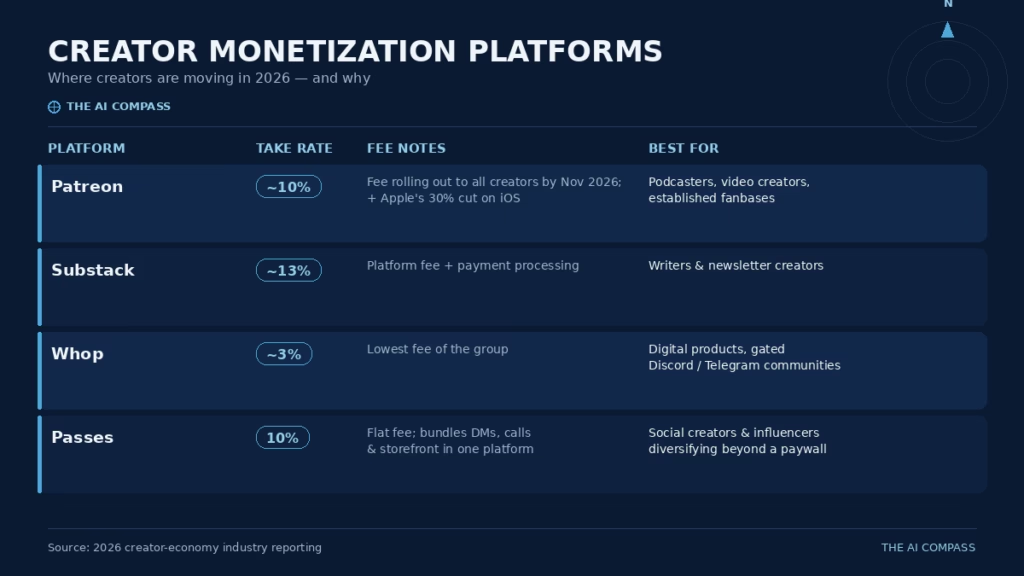
First, fees climbed. New creators joining after August 2025 pay a 10% platform fee — a rate now extending to Patreon’s long-standing legacy creators as well, effective November 2026. Layer on payment processing and currency conversion, and the effective take rate for many creators now sits well above 10%.
Second, Apple entered the picture more forcefully. Memberships purchased through Patreon’s iOS app are now subject to Apple’s standard in-app purchase commission — an additional 30% on top of Patreon’s own fee for that slice of revenue. Apple has set a hard deadline of November 1, 2026, for creators still on legacy billing arrangements to migrate to the in-app purchase system or risk removal from the App Store. For a creator whose audience skews toward iPhone users, that’s a materially different business than the one Patreon offered in 2018.
The unbundling
What’s replaced “just use Patreon” isn’t a single new default. It’s specialisation by content format — and this is the part worth paying attention to, because it mirrors a pattern executives will recognise from plenty of other markets: a category leader that served a broad audience well eventually loses ground to purpose-built challengers, each optimised for a narrower job.
Writers and newsletter publishers have largely consolidated around Substack, purpose-built for email-first publishing with its own reader-discovery network, at an effective take rate around 13% once processing is included.
Course creators and community operators — particularly those running gated Discord or Telegram access, digital products, or trading-signal style communities — have gravitated toward Whop, which charges a considerably lower fee, around 3%, though it’s a poorer fit for creators whose business is primarily subscription content rather than product or community access.
Social creators and influencers, the largest and most fragmented segment, have increasingly moved toward newer entrants like Passes, which charges a flat 10% but bundles paid direct messages, one-on-one video calls, and an e-commerce storefront into a single platform — giving creators more than one lever to pull rather than relying on a single subscription paywall.
The creator economy this is all playing out in is not small. Industry estimates put it at more than $250 billion globally in 2026, with over 200 million active creators worldwide. At that scale, a few percentage points of platform fee compound into meaningful money — which is exactly why the fragmentation happened. When the market is large enough, someone will always build a cheaper or better-fitted alternative for a specific segment.

The decision that gets hurt
If you’re advising anyone — an employee building a personal brand, a business unit experimenting with direct-to-customer content, or your own newsletter operation — the mistake isn’t sticking with an old platform. It’s assuming the platform decision is a one-time choice rather than a recurring one.
The businesses that get this right treat “which platform” as a question to revisit annually, the same way you’d revisit a payment processor or a CRM. The businesses that get it wrong are the ones still running on the assumption that made sense three years ago, discovering the true cost only when a fee change or a policy shift quietly eats into margin they didn’t realise they’d lost.
Three questions worth asking, regardless of your industry
- Is your monetisation platform still matched to your content format, or did you choose it when it was simply the best-known option?
- Do you know your effective take rate — not the headline number, but fees plus processing plus any mobile-app tax — and has it moved without you noticing?
- Are you diversified across more than one revenue lever (subscription, one-time product, direct access), or is a single paywall carrying your entire business?
None of this is a case against Patreon specifically. It’s a case for treating “the platform we chose” as a decision with an expiry date — because in a market growing this fast, the winners a year from now are rarely the same as the winners a year ago.
The AI Compass — practical guidance for business executives navigating AI and the platforms reshaping how work gets done.