

Issue #8 | AI in Marketing & Advertising | By Debiprasad Bandopadhyay.
Let’s be honest for a moment. Most business owners know they should be watching their competition more closely.
But between running operations, managing teams, and chasing revenue — who has the time to spend hours reading competitor websites, tracking their ads, and decoding their pricing strategies?
That’s exactly the gap AI was built to fill.
And no, you don’t need to be a data scientist. You don’t need a tech background. You need the right approach — and a few tools you can start using today.
This edition is your no-jargon, all-practical guide to using AI for competitive research. Let’s get into it.
Why Competitive Research Fails Most Businesses? Before we talk about AI, let’s talk about why traditional competitive research breaks down.
Most business owners do one of two things:
They over-research and under-act. Hours go into building a competitive landscape document that sits in a folder, untouched.
Or they under-research and over-assume. They think they know what competitors are doing — until a client tells them otherwise.
The real problem isn’t effort. It’s that competitive research, done manually, is slow, inconsistent, and hard to act on quickly.
AI changes the equation entirely. What AI Can Actually Do for Competitive Research (Without the Hype).
Here’s a grounded view of what AI tools can genuinely help you with — and where the guardrails are.
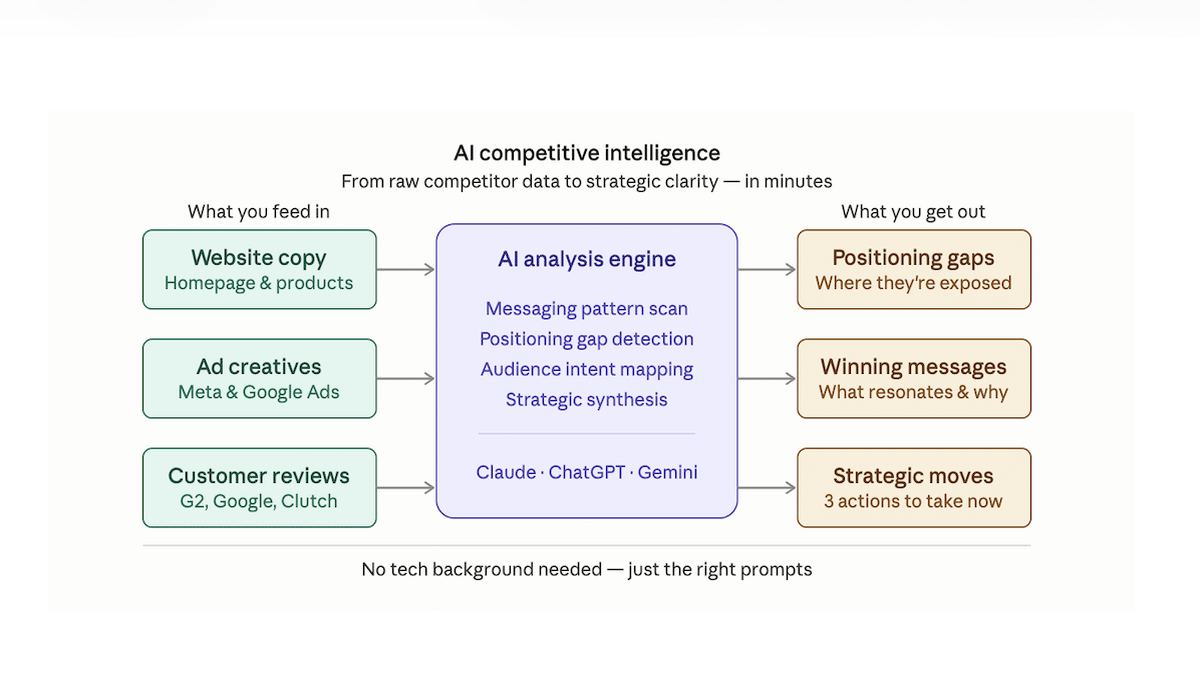
1. Analyse Competitor Messaging in Minutes.
What you do: Copy a competitor’s website homepage, About page, or product page text. Paste it into ChatGPT, Claude or Gemini with a prompt like:
“Analyse this competitor’s messaging. What value proposition are they leading with? Who is their target customer? What pain points are they addressing? What is missing from their messaging?”
What you get: A clear, structured breakdown of how your competitor is positioning themselves — in under two minutes.
Real example: A mid-sized B2B software firm in Delhi used this approach to analyse 11 competitor homepages in a single afternoon.
They discovered that every competitor was focusing on “ease of use” — but none was speaking to “integration with legacy ERP systems,” which was their clients’ actual top concern. That insight directly shaped their next campaign.
Result? 34% improvement in qualified lead conversion in the following quarter.
2. Decode Competitor Advertising Strategy.
This is where AI becomes genuinely powerful for marketers.
Use Meta Ad Library (free) and Google Ads Transparency Centre (free) to pull a competitor’s live ad creatives. Then ask AI to analyse:
- What offers are they running?
- What hooks are they using in their headlines?
- Are they going after top-of-funnel awareness or bottom-of-funnel conversions?
- What seasonal patterns do you see?
Prompt example: “Here are 10 ad copies from [Competitor X]. Identify the recurring themes, emotional triggers, and calls to action. What gaps exist that I could exploit?”
Real example: A retail apparel brand in Bengaluru analysed a competitor’s Meta ads over 90 days using this method. They noticed the competitor was heavily pushing discount-led ads — but nothing around brand storytelling or community.
The brand doubled down on “origin stories” and customer-centric content. Within 60 days, their engagement rate outpaced the competitor’s by a significant margin — without a single discount offer.
3. Monitor Competitor Content Strategy at Scale
Your competitors’ content is a goldmine of strategic intelligence.
What topics are they writing about? What LinkedIn posts are getting traction? What questions are they answering — and which ones are they avoiding?
How to do this:
- Follow your top 5 competitors on LinkedIn.
- Every two weeks, paste their last 8–10 posts into an AI tool.
Ask: “What content themes are recurring? What topics are generating high engagement? What audience problems are they consistently addressing?”
Then ask the most important question: “What are they NOT talking about that their audience is clearly asking about in the comments?”
That white space? That’s your editorial opportunity.
Real example: A financial advisory firm in Mumbai tracked four competitor LinkedIn pages this way over two months.
They found that competitors were heavy on market updates but light on client decision-making frameworks — the exact content their prospects were asking for.
The firm built a content series around “How to Make Smarter Financial Decisions in Uncertain Markets.” That series became their highest-performing content that year, generating 3x the inbound enquiries of any previous campaign.
4. Summarise Review Intelligence from Multiple Platforms
Customer reviews on G2, Trustpilot, Google, or industry-specific platforms are raw, unfiltered competitor intelligence. The problem? There are hundreds of them.
AI can synthesise thousands of words of reviews into sharp, actionable intelligence.
How to do this:
- Go to Google Reviews, G2, or Clutch for a competitor.
- Copy 20–30 reviews (both positive and negative).
Prompt: “Summarise the top 5 things customers love about this company and the top 5 recurring complaints. What unmet needs show up repeatedly?”
What you get: A clear picture of where competitors are falling short — which is exactly where you should be leaning in.
Real example: A logistics SaaS startup in Pune analysed reviews of their top three competitors this way.
A pattern emerged immediately: customers consistently praised competitor interfaces but complained about onboarding support and response times during peak periods.
The startup designed its entire go-to-market messaging around “Onboarding done in 48 hours, with a dedicated account manager from Day 1.” That single messaging shift reduced their average sales cycle by nearly 3 weeks.
5. Build a Competitive Intelligence Report — in Under an Hour
Here is what used to take a consultant a week and cost ₹1–2 lakhs.
You can now build a working competitive intelligence brief using a structured AI workflow:
Step 1: Compile information — competitor website text, ad copy, recent blog posts, LinkedIn content, pricing pages, press releases.
Step 2: Feed it to AI in structured sections with clear prompts.
Step 3: Ask AI to synthesise it into: positioning summary, strengths and weaknesses, key messaging pillars, target audience profile, and apparent strategic priorities.
Step 4: Ask the final question — “Based on this competitor’s strategy, what are the 3 strategic gaps I could exploit if I were entering their market?”
You now have a working competitive brief you can share with your marketing and sales team.
A Note on What AI Cannot Do
It is better to be straight with you here, because honest guidance matters more than hype.
AI cannot access paywalled databases, proprietary CRM data, or internal competitor financials. It cannot tell you what a competitor is planning — only what they are showing.
And it can occasionally hallucinate facts if you ask it to fill in gaps without source material.
The rule is simple: Feed AI real data. Use AI to analyse, not to invent.
The research is still yours to gather. The synthesis, pattern recognition, and strategic framing — that’s where AI earns its keep.
Your Action Plan for This Week
Start small. Pick one competitor. Do one of the five exercises above. See what you discover.
Here’s a starter prompt you can use right now:
“I am a [describe your business] competing against [describe competitor type]. Here is their website homepage text: [paste text]. Please identify: (1) their core value proposition, (2) their target customer profile, (3) the key pain points they are addressing, (4) what they are NOT saying that their customers probably want to hear, and (5) three positioning angles I could use to differentiate from them.”
Paste that into any AI tool. Run it in the next 30 minutes.
You will walk away with at least one insight you did not have before.
Final Thought
Competitive intelligence used to be a luxury that only large corporations with dedicated research teams could afford. That asymmetry is gone.
Today, a solo founder, a growing SME, or a mid-market marketing team can have the same quality of competitive insight as a Fortune 500 brand — if they know how to work with AI.
The businesses that win the next decade won’t necessarily be the ones with the biggest budgets. They will be the ones who learn fastest.
AI is your learning accelerator. Use it.
NOTE: I have prepared a 30-DAY AI-POWERED COMPETITIVE RESEARCH PLAN for your immediate implementation. Drop a comment if you want the link.
If this was useful, share it with a business owner who needs it. That’s how we build smarter businesses together.