
There is no shortage of AI enthusiasm in boardrooms right now. Strategy decks reference it, budgets allocate for it, and almost every vendor pitch ends with the words “AI-powered.”
But enthusiasm without clarity is expensive. Over the past year, we have watched businesses make costly decisions — delayed adoption, misdirected investment, and missed opportunities — not because they lacked access to good AI tools, but because they were operating on faulty assumptions about what AI actually is and how it actually works.
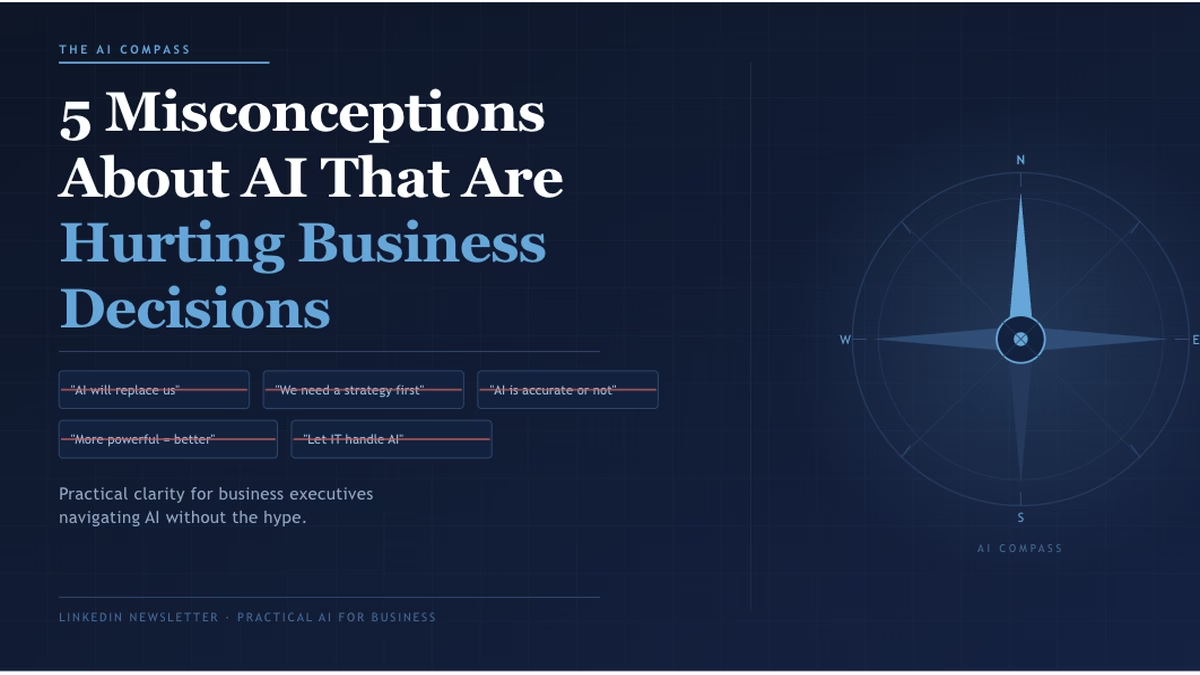
Here are five misconceptions we see most often, and why each one matters to your bottom line.
Misconception #1: “AI will replace our team — so let’s wait and see”
This may be the most common reason businesses delay adoption, and it is also the most misunderstood.
The reality is that most enterprise AI tools today are not replacing roles — they are restructuring workflows. A legal team using AI to review contracts still needs lawyers to make judgments. A marketing team using AI to generate copy still needs editors to maintain voice, accuracy, and strategy. What changes is where skilled time gets spent.
The danger of “wait and see” is that while you are watching, your competitors are building operational muscle with these tools. The gap is not about the technology — it is about experience. Teams that start now will have 18 months of learning by the time you begin.
The decision that gets hurt: Delayed investment in AI tools that would have measurably reduced operational costs.
Misconception #2: “We need an AI strategy before we can start”
Strategy is important. But many organisations are using strategy as a synonym for permission — a way to defer action while sounding responsible.
Here is what we have seen work better: start with a use-case inventory. Identify three to five workflows in your business where quality, speed, or cost is a persistent problem. Then ask whether AI can address even one of those specific problems. Run a focused, time-bounded pilot. Let the evidence inform the strategy, not the other way around.
Waiting for a fully formed AI strategy before starting any pilots is like deciding to learn swimming only after you have studied all the theories of hydrodynamics.
The decision that gets hurt: Paralysis. Months of internal alignment work produce a strategy document that is already outdated by the time it is approved.
Misconception #3: “AI output is either accurate or it isn’t — you can tell which”
This one is dangerous because it is partially true, which makes it harder to challenge.
Yes, AI can produce confident-sounding incorrect information — hallucinations, as they are called. But the deeper problem is that AI errors are not random. They are systematic and difficult to detect without domain knowledge. An AI summarising a financial report might quietly omit a key caveat. An AI generating a market analysis might reflect outdated assumptions from its training data without flagging them as such.
The correct mental model is not “AI is accurate” or “AI is unreliable.” The correct model is: AI output requires a calibrated reviewer. Not someone who reads every word with suspicion, but someone who knows what to check and why. This is a skill that needs to be built deliberately, not assumed.
The decision that gets hurt: Organisations deploy AI without investing in the training needed to use it well, and then blame the tool when errors surface.
Misconception #4: “More powerful AI means better results for our business”
This is the misconception that benefits AI vendors the most.
Businesses routinely over-invest in capability and under-invest in implementation. The most powerful large language model in the world will underperform a simpler tool that has been well-integrated into your existing workflow, given clear instructions, and connected to accurate, relevant data.
We have seen a ₹50,000/month enterprise AI subscription produce worse outcomes than a well-configured ₹5,000/month tool — because the expensive subscription sat poorly integrated in a workflow nobody had redesigned.
The question to ask is not “which AI is most powerful?” It is “which AI fits best into how our team actually works, with the data we actually have?”
The decision that gets hurt: Budget allocated to premium AI capability without equivalent investment in workflow redesign and change management.
Misconception #5: “AI is a technology decision — let IT handle it”
This may be the most structurally damaging misconception of all, because it misassigns ownership.
AI implementation that lives only in the IT department tends to produce tools that are technically functional but operationally ignored. The most successful AI deployments we have observed were driven by business unit heads who understood the problem deeply enough to specify what they needed — and then worked with IT to build or procure it.
The reason is straightforward: AI tools work best when they are shaped by the people who understand the actual workflow, the real exceptions, and the judgment calls that no process map captures. IT can evaluate infrastructure and security. But the business team must own the outcomes.
The decision that gets hurt: AI tools that get deployed, used briefly, and quietly abandoned — because the people who needed to adopt them were never involved in designing how they would work.
The pattern beneath the misconceptions.
All five of these misconceptions share a common thread: they treat AI as a binary — either transformative or threatening, either accurate or not, either worth having or not worth starting. The reality is more nuanced and, frankly, more manageable.
AI is a capability multiplier – How much it multiplies depends almost entirely on what you bring to it: clear problems, good data, trained people, and workflows that have been genuinely rethought — not just had AI bolted on.
The businesses that will pull ahead are not those with the biggest AI budgets. They are the ones making the clearest-eyed decisions about where, how, and why to use it.
The AI Compass is a practical newsletter for business executives navigating AI without the hype. If a colleague would benefit from this, please share it with them.
Have you encountered a misconception in your own organisation? I would like to hear about it — reply to this newsletter or connect with me on LinkedIn.