
There’s a reason the supply chain became the business buzzword of the last five years. Pandemic disruptions, shifting demand patterns, and rising logistics costs exposed a painful truth: most businesses were running on gut instinct dressed up as spreadsheets.
The companies that came out ahead weren’t necessarily the biggest. They were the ones who had already started letting data — not intuition — drive their supply chain decisions.
Walmart is the most instructive case study available. Not because you can replicate what they’ve built. You can’t — and frankly, you shouldn’t try. But because buried inside their AI journey are four principles that scale down remarkably well to a ₹50 crore manufacturer or a 15-outlet retail chain.
Let’s dig in.
What Walmart actually built.
Walmart operates one of the most complex supply chains on earth — thousands of suppliers, millions of SKUs, retail stores plus e-commerce, across multiple countries. Their AI investment isn’t a single product or a chatbot bolted onto a portal. It’s a set of interconnected engines.
Demand forecasting at the core. Walmart built a multi-horizon recurrent neural network entirely in-house to predict demand across multiple points in the future.
The model ingests past demand patterns, planned future events, and current global and local trends — and it stores its past predictions across different planning horizons so it can learn from its own errors.
The result: inventory levels are planned more accurately, well in advance, with less safety stock sitting idle in warehouses.
Dynamic inventory rebalancing. If an item starts selling faster in one region than another, Walmart’s AI models dynamically adjust how inventory flows across the network — shifting supply to where demand is actually materialising, not where it was predicted six weeks ago. This is a fundamentally different operating model from traditional quarterly replenishment planning.
Route optimisation that eliminates waste. Walmart’s route optimisation AI analyses truck capacity, delivery locations, store receiving hours, traffic patterns, and weather forecasts in real time to map the most efficient multi-stop journeys.
The system also plans “backhauls” proactively — ensuring a truck making a delivery picks up goods from a supplier on the return trip, eliminating empty miles.
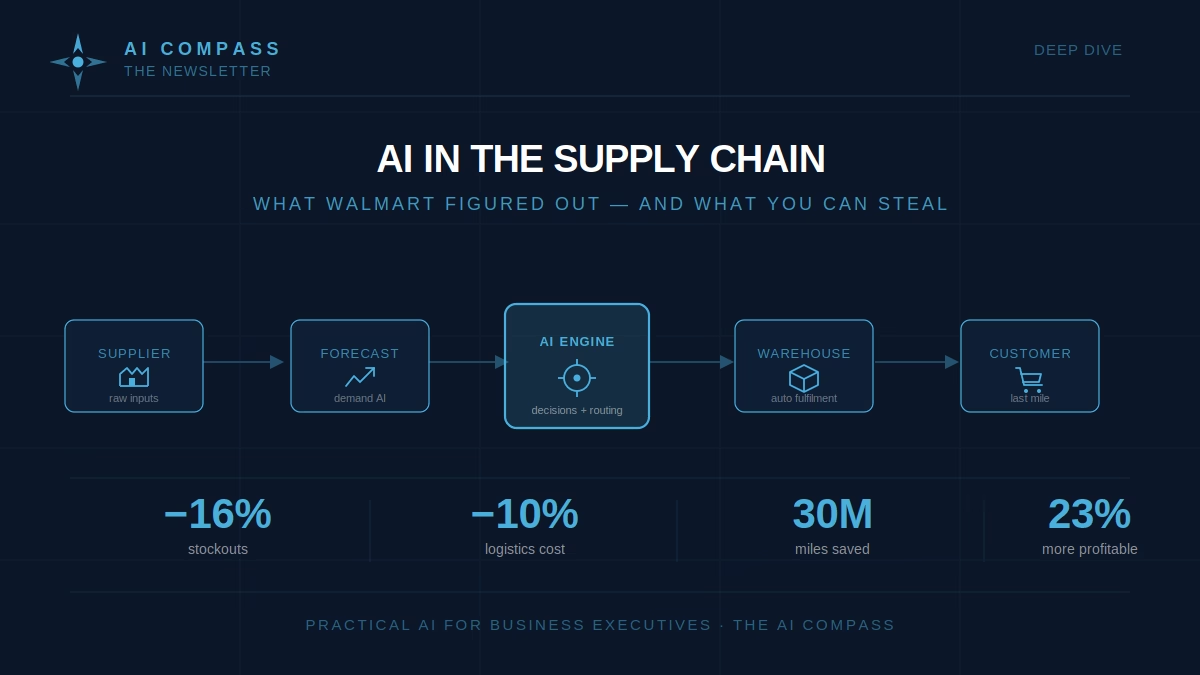
The outcome: 30 million fewer unnecessary driving miles.
Warehouse automation at scale. Walmart is targeting 65 per cent warehouse automation, with over half of fulfilment centre operations already automated — robots handling storage, retrieval, and packing, reducing reliance on manual labour and improving order fulfilment times.
The measurable results? A 16 per cent reduction in stockouts, a 10 per cent improvement in inventory turnover, a 10 per cent reduction in logistics costs, and a 2.5 per cent increase in overall revenue. At Walmart’s scale, these aren’t incremental improvements — they’re billions of dollars.
What does this have to do with your business?
Here’s the uncomfortable truth about most AI-in-supply-chain coverage: it shows you what’s possible at enterprise scale and then leaves you with nothing actionable.
So let me try to bridge that gap.
Walmart’s AI stack has three things most smaller businesses don’t: proprietary training data accumulated over decades, hundreds of ML engineers, and the capital to build custom systems from scratch. You have none of those, and you don’t need them.
What you can take from the Walmart playbook is the logic — not the technology.
Four lessons that actually translate
1. Start with one problem, not a platform.
The most effective approach is to start with a single AI application, then add more over time that optimise different parts of the business. A company might begin by focusing entirely on avoiding stockouts and using AI to optimise inventory levels — building a solid foundation before expanding to other tasks.
Walmart didn’t build a unified AI supply chain overnight. They started with demand forecasting. Pick your single most painful problem — stockouts, excess inventory, delayed supplier deliveries — and solve that first. Prove the ROI in one place before expanding.
2. Your data quality matters more than your AI tool.
Walmart’s demand forecasting works because they have clean, structured, historical data at granular levels — by store, by SKU, by day. Most smaller businesses are sitting on fragmented data across an ERP, a few Excel sheets, and someone’s WhatsApp order history.
Before you buy any AI tool for the supply chain, spend a month consolidating and cleaning your data. The tool is only as good as what you feed it.
3. The goal is better decisions, not full automation.
Ninety-four per cent of supply chain companies plan to use AI for decision support — not to replace decisions, but to make better ones faster.
Walmart’s own framing is instructive here: they describe being “people-led and tech-powered.” The AI surfaces the recommendation; the associate acts on it.
For a smaller business, this is the right mental model. You’re not trying to replace your procurement manager or your logistics coordinator. You’re giving them better information to work with.
4. Measure ruthlessly from day one.
2026 is the year that separates supply chain leaders who can demonstrate ROI from those who cannot. Companies that can show faster cycle times, documented cost savings, and business-impact metrics that CFOs trust will secure continued backing — those that cannot will see budgets reallocated.
Define your baseline before you start: current stockout rate, current inventory days-on-hand, current logistics cost as a percentage of revenue. Then measure monthly. If the numbers aren’t moving after 90 days, the problem is either the tool or the data — and you need to know which.
Where to start this week.
You don’t need an ML engineer or a seven-figure budget. Here’s a practical entry point:
Most modern ERPs — SAP Business One, Zoho Inventory, even Tally with the right add-ons — now include AI-assisted demand forecasting modules. If you’re not using those features yet, that’s your first call to make.
If you’re not on an ERP, tools like Inventory Planner, Reorder Point (for e-commerce), or Netstock offer AI-driven demand forecasting for mid-sized businesses at a fraction of enterprise pricing.
The point isn’t which tool you pick. The point is that you stop treating demand forecasting as a manual exercise done once a quarter by someone with a spreadsheet and a prayer.
The real competitive advantage.
Companies with AI-mature supply chains are 23 per cent more profitable than their peers — and that gap is widening, not closing.
But here’s what that statistic doesn’t say: the companies closing the gap aren’t the ones who spent the most on AI. They’re the ones who were most disciplined about where they applied it.
Walmart’s lesson isn’t “deploy AI everywhere.” It’s “deploy AI where the data is cleanest, the decision is most repetitive, and the cost of error is highest.” In the supply chain, that’s almost always demand forecasting first.
Everything else follows from getting that right.
What’s your biggest supply chain headache right now — stockouts, excess inventory, or supplier unpredictability? Reply and let me know. The next deep dive will go where the pain is.