


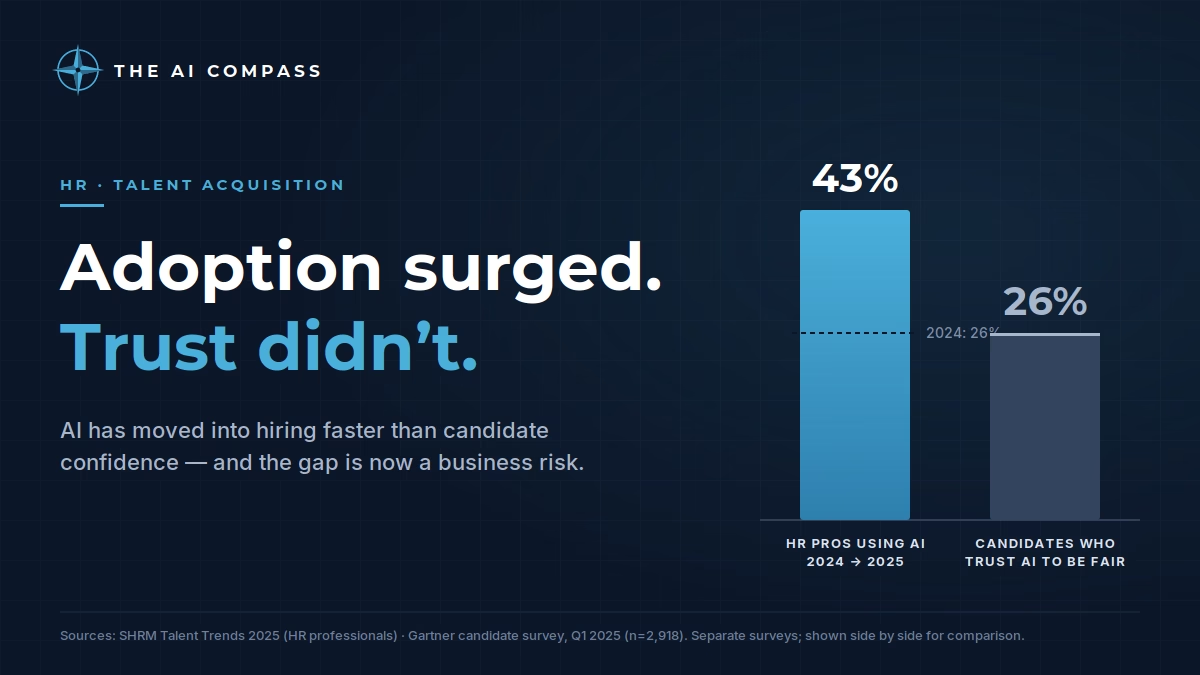
AI has moved into hiring faster than almost any other HR function. Candidates haven’t come along for the ride — and that gap is now a business risk, not an HR footnote.
Years ago, when I was taking a new way of learning for the working executives (M’Power) into some of India’s larger companies, I learnt something that no sales training had taught me. The technology (video-audio-text) was never the hard sell. Understanding was. Until the people on the receiving end understood what the new method was doing and why, they resisted it — politely, but firmly.
I’ve been thinking about that lesson while reading this year’s research on AI in hiring. Because the same pattern is repeating, on a much larger scale.
The adoption side of the ledger.
The speed is real. SHRM’s 2025 Talent Trends research found the share of HR professionals using AI for HR tasks rose from 26% in 2024 to 43% in 2025 — a 17-point jump in a single year.
SHRM’s State of AI in HR 2026 report, based on a survey of more than 1,700 HR professionals, found that recruiting is the single most common use of AI inside HR, at 27% of organisations.
Candidates are feeling it. Greenhouse’s 2026 Candidate AI Interview Report, which surveyed 2,950 active job seekers across the US, UK, Ireland, Germany and Australia, found that 63% of US job seekers have now been interviewed by AI — up 12 percentage points in just six months.
By any measure, that is fast.
The trust side of the ledger.
Now look at the other column.
A Gartner survey of 2,918 job candidates in early 2025 found that only 26% trust AI to evaluate them fairly — even though 52% believe AI is already screening their applications. A quarter said they trust an employer less if it uses AI to evaluate them.
Greenhouse’s 2026 data points the same way. Only 17% of US candidates trust AI more than a human interviewer to judge them fairly; 54% favour the human. And only 21% believe most employers are using AI responsibly and transparently.
There is a curious symmetry here. The share of HR professionals using AI in 2024, and the share of candidates who trust it to be fair: both 26%. One of those numbers has moved sharply. On the evidence we have, the other hasn’t. (A fair caveat: these are different surveys of different people, so treat this as an illustration, not a trend line.)
Where the gap actually bites.
If this were only about attitudes, it would be an interesting survey finding. It isn’t. It shows up in behaviour.
Disclosure. Of US candidates who went through AI evaluation, 70% say they weren’t clearly told beforehand. One in five only found out when the interview began.
Walkouts. 38% of US candidates have withdrawn from a hiring process specifically because it included an AI interview, and another 12% say they would.
The top triggers: pre-recorded video interviews scored by AI with no human present (33%), and companies not disclosing how AI would be used (27%).
Silence. Of US candidates who completed an AI interview, 51% never received an outcome. 38% simply never heard back.
Brand. 34% of US candidates said an AI interview left them with a more negative view of the employer. In the UK, negative reactions outnumbered positive ones by 20 points.
Now consider who walks away. It’s the candidate with options. The strongest people in your pipeline are precisely the ones who can afford to decline an experience they find impersonal. Efficiency at the top of the funnel can quietly cost you quality at the bottom — and that cost never appears on the dashboard that shows time-to-hire falling.
There’s a second cost. In many businesses, candidates are also customers, distributors, or future clients. Someone who felt processed by a machine and then ghosted doesn’t simply disappear. They remember, and they talk.
The arms race nobody wins.
It would be unfair to paint candidates as passive victims. They are using AI too. Gartner found 39% of candidates used AI during the application process, mostly to write CVs and cover letters. In a separate survey, 6% admitted to interview fraud — posing as someone else, or having someone pose as them. Gartner predicts that by 2028, one in four candidate profiles worldwide will be fake.
So employers add more automated screening. Candidates respond with more automated applications. Each side’s automation erodes the other’s trust, and the cycle feeds itself.
Somebody has to go first on transparency. The employer holds most of the cards, so it’s the employer’s move.
Candidates aren’t asking for less AI.
This is the part of the research I find most useful, and most reassuring.
In Greenhouse’s 2026 data, only 19% of US candidates want less AI in hiring. 22% actually want more AI, with stronger human oversight at key decisions; another 21% want the same level, with more transparency.
And when asked what would make them more comfortable, their top requests were remarkably modest: the option to ask for a human interview instead (46%), being told upfront that AI is involved (44%), a clear explanation of what the AI is measuring (39%), and knowing a human reviews the AI’s evaluation (38%).
None of that requires abandoning the technology. Most of it is simply good manners, applied consistently.
The India lens.
Indian sentiment is somewhat warmer. A survey by the Association of Chartered Certified Accountants, reported by IANS this month (secondary report), found 52% of Indian respondents confident about AI algorithms in hiring, against 43% globally.
But the pressure is also higher. LinkedIn reports that applications per job opening in India have more than doubled since early 2022, and 84% of Indian professionals say they feel unprepared to find a new job in 2026.
Higher confidence combined with overwhelming volume is exactly the environment in which employers are tempted to automate aggressively — and in which a careless candidate experience travels fastest.
Two regulatory clocks are also worth knowing about:
- India’s DPDP Rules, notified in November 2025, bring the substantive obligations — notice, consent and data principal rights — into force on 13 May 2027. This isn’t an AI-in-hiring law, but candidate data is personal data. Clear, upfront notice is moving from courtesy to legal expectation.
- The EU AI Act classifies AI used in employment decisions as high-risk. After the Digital Omnibus amendments this summer, those obligations now apply from 2 December 2027. For Indian IT services firms and GCCs that recruit in Europe, the delay is breathing room, not an exemption.
(As always, this is context for your planning conversations, not legal advice. Your counsel should have the final word.)
Five things worth doing this quarter.
1. Disclose before, not during. Tell candidates in the job posting or first communication where AI is used and what it assesses. Finding out mid-interview is the single biggest trust-breaker in the data.
2. Keep a human door open. Offer a human alternative at the stages where AI does the evaluating, especially one-way video interviews. Most candidates won’t take it. Knowing it exists is what matters.
3. Close every loop. If your AI can screen a thousand applicants overnight, it can also send a thousand clear, courteous outcome messages. Ghosting at scale is a choice, not a limitation.
4. Ask your vendor the uncomfortable questions. What exactly is the tool measuring? How has it been tested for bias? Can you explain a specific rejection if challenged?
Greenhouse’s candidates reported similar rates of perceived bias from AI and human interviewers — AI is not automatically fixing the problem. And in the US, the Mobley v. Workday case, which alleges age discrimination by AI screening, has been allowed to proceed as a collective action. Accountability is arriving.
5. Measure trust the way you measure speed. Track withdrawal rates at AI-assisted stages, candidate feedback scores, and time-to-response alongside time-to-hire. What gets measured gets managed; right now, most dashboards measure only one side of the ledger.
The bottom line.
Adoption is a decision you make. Trust is a verdict others give you.
The organisations that get the most from AI in hiring won’t be the ones that automated the most. They’ll be the ones that good candidates still want to apply to — once they know exactly how they’ll be assessed.
If you lead HR or a business function that hires at scale: what’s one thing your organisation tells candidates about AI today? And what you don’t tell them yet? I’d genuinely like to know.
The AI Compass.


