
Back when I was selling a management education programme for working executives, M’Power, I found myself on the shop floor of a Hero Honda (earlier name) plant with nothing but a laptop, presenting it to a group of engineers. None of them had asked for a class. Most had years of experience and very little patience for anything that sounded like theory.
What changed the room was not the programme brochure. It was the moment the conversation turned to their plant, their shift problems, their next promotion. The questions came fast after that.
I have thought about that afternoon often this year, because the same group is back in the spotlight. Only now the subject is AI, and the people in question are the 40- and 50-something managers who run most of our departments.
The common assumption is that they are the hardest people to retrain.
My experience, and a growing body of data, suggests something different: They are not resistant to learning. They are resistant to learning that ignores what they already know.
The group we keep overlooking.
Start with the scale of the task. The World Economic Forum’s Future of Jobs Report 2025, based on a survey of more than 1,000 employers, estimates that if the global workforce were 100 people, 59 would need reskilling or upskilling by 2030. Employers expect 11 of those 59 to miss out on the training they need.
Who is most likely to be among those 11? Surveys point uncomfortably at experienced workers.
In the United States, AARP’s ongoing study of workers aged 50 and above found in its March 2026 wave that interest in AI training sits far above actual participation — a gap of 37 percentage points. A separate AARP employer study reports that about 46% of employers say workers aged 40 and above make most or all decisions about how AI is used in their organisations. In other words, the people steering AI adoption are among the least trained in it.
India’s picture is more encouraging, but it points in the same direction. Indeed’s India workforce study, conducted in May 2025 among 3,001 workers, found professionals aged 35 to 54 were the most confident about navigating AI-driven change, at 49%.
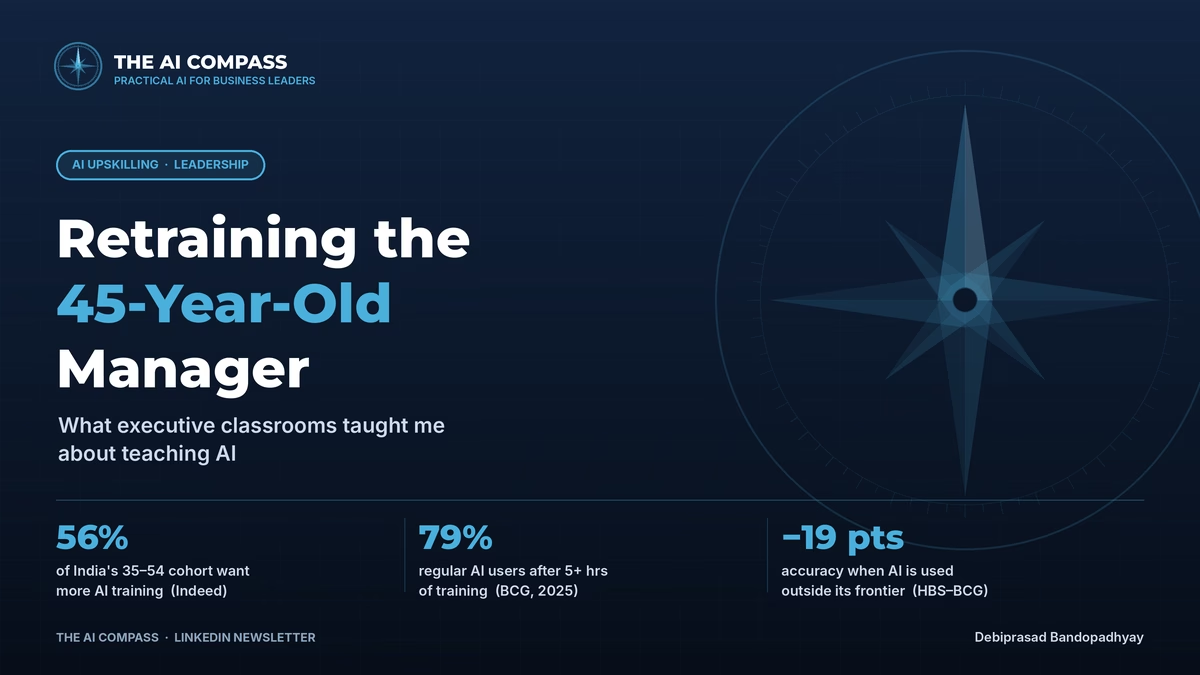
The same group was also hungrier for training: 56% wanted significantly more of it, against 41% of younger workers.
A word of caution on these numbers. The AARP data is American, and Indeed is a hiring platform reporting on its own survey. Self-reported readiness is not the same as capability. But the direction is consistent across sources: experienced managers want this, and organisations are not giving it to them in a form they can use.
Why the 45-year-old manager matters more than the 25-year-old analyst.
There is a practical reason to prioritise this group, and it has little to do with fairness.
Researchers from Harvard, Wharton and MIT ran the best-known experiment on AI at work. They gave 758 Boston Consulting Group consultants a set of realistic tasks. On the tasks AI could handle well, the consultants who used it worked faster and produced better work.
Then the researchers included one task that AI could not handle well. On that task, consultants using AI got the right answer 19 percentage points less often than colleagues working without it. The tool sounded just as confident as before. Nothing told them they had crossed a line. The researchers named that invisible line the “jagged frontier.”
The study does not show that experience protects you from that trap. What it shows is that the valuable skill is knowing when the machine is confidently wrong. That judgment is built from years of seeing how customers, plants, markets and people actually behave.
Your 25-year-old analyst can learn the tool in an afternoon. The judgment to overrule it usually sits two levels above.
BCG’s 2026 AI at Work survey adds a second reason. Among frontline employees who use AI regularly, 42% report saving a full workday each week, yet 66% say they get limited or no guidance on what to do with that time. Deciding how saved hours become better work is a manager’s job. An untrained manager cannot do it.
Five lessons from the executive classroom.
Over the years I spent selling, designing and later heading management education for working executives, a few patterns held regardless of company or decade. Each applies directly to AI today.
1. Start with their problem, not the tool. Adult learning research — Malcolm Knowles’ work on andragogy is the classic reference — has long held that experienced adults learn best when training addresses problems they are already facing. A two-hour “Introduction to Generative AI” session will be forgotten by Friday. A session where a regional sales head uses AI to rebuild his own territory review will not. Design training around five or six real tasks from each function, and let the tool appear inside them.
2. Protect dignity before you teach skills. The unspoken fear of a senior manager is not the technology. It is looking slow in front of juniors. In our programmes, the most productive sessions were the ones where peers learned alongside peers. For AI, that means early training cohorts grouped by seniority, private practice time before public use, and no expectation that a general manager will learn prompt techniques in the same room as the interns he appraises.
3. Invest in hours and coaching, not a login. BCG’s 2025 AI at Work survey found that 79% of employees who received more than five hours of training were regular AI users, against 67% of those who received less. It also found that in-person sessions and coaching made a clear difference. Handing a 45-year-old a Copilot licence and a video library is not a training programme. It lets the organisation report that training was provided while leaving the manager to work it out alone.
4. Win top management first. When we introduced our online programme over company LAN networks — at a time when the public internet was still nascent in India — no organisation adopted it until its top management understood the method. The same dynamic applies now.
BCG found that the share of employees who feel positive about generative AI rises from 15% to 55% when they see strong leadership support. The 45-year-old manager watches what his own boss does with AI far more closely than what the HR circular says.
5. Don’t turn learning into one more burden. Experienced employees are often the most stretched people in the organisation. Research on older workers in Canada, reported this August, suggests that poorly timed or poorly supported digital training can become an additional job demand that pushes burned-out employees towards leaving.
Indeed’s Indian respondents said something similar in plainer terms: some asked employers to set aside time during working hours for learning. If AI training is scheduled only after 7 p.m., you have told your managers it matters less than their day job — and they will treat it exactly that way. Anything a company genuinely values gets time inside working hours.
The honest caveats.
Not every mid-career manager will adapt, and age is not destiny in either direction. Some 28-year-olds will struggle; some 55-year-olds will become your best internal champions. The evidence here is also uneven. Much of the age-specific research is American; India-specific data comes mainly from platform-run surveys, and very little of it tracks what happens to productivity after training.
There is also a harder reality. Experienced workers in AI-exposed roles face genuine career risk, and training is not a guarantee against restructuring. Leaders should be honest about that rather than presenting upskilling as a promise it cannot keep.
The institution decides whether learning sticks.
One of my proudest moments from those years was when Asian Paints made our entry-level programme mandatory for its junior executives to qualify for any higher level of training. It taught me something I did not fully appreciate then. Individual motivation gets people into a classroom. Institutional commitment — time, budget, visible leadership, a link to real work — decides whether anything changes afterwards.
The same will be true of AI. Your 45-year-old managers carry the judgment your AI investments most need. Whether they bring it to the table depends less on their age than on how seriously you design their learning.
Here is my question for you: in your organisation, who received AI training first — the people doing the tasks, or the people deciding how the work should change? I would genuinely like to hear how you made that call.
Every statistic in this issue is traced to a named, dated source.