
A Practical Playbook
There is no business function where the gap between AI hype and AI reality is wider than in sales.
On one end, you have vendors promising that AI will automate your entire pipeline, replace your sales team, and triple your revenue while you sleep. On the other hand, you have seasoned sales leaders dismissing AI as a glorified autocomplete tool that couldn’t close a deal if its existence depended on it.
The truth, as usual, sits somewhere between these extremes — and it is far more useful than either camp suggests.
The fact of the matter is, AI does not sell. But a salesperson who uses AI intelligently will consistently outperform one who does not — in output, in preparation, and increasingly, in results.
This newsletter is a practical walkthrough of the entire sales cycle — stage by stage — showing you exactly where AI earns its place, where it falls short, and where human judgment remains not just useful but essential.
First, a Useful Mental Model:
Before we walk through the sales cycle, here is a mental model that will serve you well throughout this piece.
Think of AI as your most diligent, tireless junior colleague — one who can read faster than any human, draft cleaner prose than most, and never gets tired or impatient. But this colleague has never met a client, never sensed hesitation in a voice, never built a relationship over three years, and cannot read a room.
Your job as the senior professional is to use this colleague’s extraordinary capabilities while never abdicating the parts of the sale that require human presence, intuition, and trust
With that framing, let us begin.
Stage 1: Prospecting — Finding the Right People, Faster – Where AI genuinely helps:
Prospecting is traditionally one of the most time-consuming and inconsistent parts of sales. It involves researching potential clients, identifying decision-makers, understanding their business context, and qualifying whether they are worth pursuing — before you have even made contact.
This is precisely where AI delivers immediate, measurable value.
Research acceleration:
Give an AI tool a company name and ask it to summarise: the company’s business model, recent news, likely pain points, organisational structure, and key decision-maker profiles. What would take an experienced sales executive 40–60 minutes — scanning the website, recent press releases, LinkedIn profiles, and industry news — now takes 8–10 minutes with AI doing the heavy lifting, while you review and add your own judgment.
Ideal Customer Profile (ICP) matching: If you describe your best existing clients to an AI — their industry, size, structure, buying behaviour — it can help you articulate a sharper ICP and suggest parameters to look for when evaluating new prospects. This is not magic, but it is faster and more systematic than doing it in your head.
List enrichment: If you have a list of company names or contacts, AI can help you quickly build a context brief on each — so your team goes into outreach calls informed rather than improvising.
A real example: A B2B technology solutions firm in Pune was spending 2–3 hours per prospect on manual research before their first sales call. After training their team to use Claude with a structured research prompt template, the same pre-call brief now takes 25–30 minutes — and is more comprehensive. The team now handles 40% more prospect conversations per week with the same headcount.
Where human judgment is irreplaceable: AI cannot tell you which prospects are worth your time. It can give you data. But the judgment call — does this company have the budget, the urgency, and the right culture to be a genuine buyer? — requires experience, intuition, and often a well-placed phone call. Never outsource your qualification instincts to an algorithm.
Stage 2: Outreach — Writing Messages That Actually Get Read – Where AI genuinely helps:
Most sales outreach is forgettable. It is generic and self-centred, arriving at the wrong moment with the wrong message. AI does not fix the strategy — but it dramatically reduces the time it takes to write better outreach at scale.
Personalised first drafts. The combination of your AI research brief (Stage 1) and a well-structured prompt gives you a personalised outreach email or LinkedIn message in minutes. The keyword is draft — your job is to read it, add what only you know (the mutual connection, the specific reference to their recent announcement, the tone that matches who you are), and send something that sounds human.
Subject line testing. Ask AI to generate 8–10 subject line variants for the same email, ranging from direct to curious to benefit-led. Then use your own judgment to pick the one that fits your style and the recipient’s likely mindse
Multi-channel sequencing. If you run a multi-touch outreach sequence (email → LinkedIn → call → follow-up email), AI can draft each touchpoint in minutes, maintaining consistent messaging while adjusting the tone for each channel.
Prompt example you can use today:
“You are a B2B sales professional. Draft a short, personalised LinkedIn message to [Name], [Title] at [Company]. They recently [specific trigger event — e.g., expanded into a new city / launched a new product]. My company helps [your ICP] solve [core problem]. The message should be under 80 words, conversational, focused entirely on them, and should not pitch anything directly. End with a soft question.”
The output will not be perfect. But it will be 80% of the way there, and editing is always faster than writing from scratch.
Where human judgment is irreplaceable: AI cannot sense how warm or cold a prospect is. It does not know that your contact just changed jobs, that there is political tension inside their organisation, or that the last email you sent went unanswered because of a personal loss they experienced. Personalisation at the human level — the kind that builds genuine rapport — cannot be templated. AI gives you speed. You provide the soul.
Stage 3: Discovery and Preparation — Walking In Ready
Where AI genuinely helps: The discovery meeting is where deals are genuinely won or lost. And the single biggest differentiator between average and excellent salespeople is preparation.
Pre-meeting briefs: We covered this in detail earlier (using Claude to prepare for business meetings). The same principles apply here with a sales-specific lens: who is in the room, what their stated priorities are, what their company’s recent challenges look like, and what your strongest angle is for this particular conversation.
Question generation: Ask AI to generate discovery questions for a specific client type and context. You will not use all of them. But reviewing 20 sharp questions — and picking the 6 that feel right — is far more powerful than improvising in the moment.
Objection preparation: This is underused and underrated. Before any major sales meeting, prompt AI to play devil’s advocate: “What are the five most likely objections a [CFO / procurement head / MD] at a mid-size manufacturing company would raise against adopting [your solution] — and what are the most credible, honest responses to each?”
What you get is not a script. It is a thinking exercise that surfaces angles you may not have considered, and ensures you are not caught flat-footed in the room.
Competitive positioning: If you know a prospect is also speaking with a competitor, ask AI to outline the key differences between your offering and theirs — strengths, weaknesses, and the situations where each genuinely wins. This builds the kind of nuanced positioning that builds buyer confidence.
Where human judgment is irreplaceable: Preparation is not performance. The best salespeople walk into a discovery meeting with deep preparation and the discipline to listen rather than follow their script. AI prepares you for the meeting. It cannot conduct it. The ability to follow an unexpected thread in the conversation, to sense when a prospect is sharing something important beneath the surface, to build genuine trust in real time — these are entirely human capabilities.
Stage 4: Proposals and Presentations — Clarity That Converts
Where AI genuinely helps: A proposal is a written argument for why the prospect should choose you. Most proposals are too long, too generic, and too focused on the seller rather than the buyer.
Structure and narrative: AI can help you restructure a proposal around the client’s stated priorities — leading with their problem, then your approach, then your proof, then the investment. This buyer-centric sequencing is one of the most impactful improvements in any proposal, and AI does it well when given good inputs.
Executive summary drafting: The most-read section of any proposal is the executive summary — and it is often the weakest. AI can produce a sharp, punchy first draft that your senior team can refine, ensuring the summary reflects the client’s language and priorities rather than your own.
Simplifying complex technical content. If your offering involves technical details, AI can translate them into plain, benefit-led language that a non-technical decision-maker can understand and champion internally.
A real example: An enterprise software firm in Bengaluru was sending proposals that their prospects consistently forwarded to procurement without any internal advocacy — a sign that the proposals were not compelling enough for internal champions to sell on their behalf. After restructuring their proposal template using AI (the executive summary was rewritten to mirror the prospect’s language, technical sections were simplified, and ROI was quantified upfront), their internal champion engagement — measured by questions asked after proposal submission — increased noticeably within two months.
Where human judgment is irreplaceable: A proposal is not just a document. It is a signal of how you work. Your responsiveness, your attention to the details the client mentioned in the meeting, your willingness to customise — these are what separate a proposal that wins from one that loses on price. AI can help you write faster and more clearly. Only you can ensure it reflects the specific conversation you had
Stage 5: Follow-Up — The Stage Most Salespeople Abandon Too Early
Where AI genuinely helps: Research consistently shows that most deals require multiple follow-up touchpoints — and most salespeople give up too early. The reason is not laziness. It is that writing thoughtful, non-pushy follow-ups that add value rather than just checking in is genuinely hard.
AI makes this significantly easier.
Value-add follow-ups: Instead of “just checking in,” prompt AI to draft a follow-up that includes a relevant insight, a recent industry data point, or a short case study relevant to the prospect’s situation. These add-value touchpoints are far more likely to earn a response.
Objection follow-up letters. If a prospect raised a specific concern in a meeting — pricing, implementation risk, internal buy-in — AI can help you draft a thoughtful written response that addresses the concern thoroughly and positions your solution honestly.
Re-engagement sequences: For prospects who have gone quiet after initial interest, AI can draft a sequence of re-engagement messages — spaced over weeks — that are non-aggressive, genuinely useful, and keep you front of mind without being irritating.
Where human judgment is irreplaceable:
Knowing when to follow up and when to let go is one of the most nuanced skills in sales. AI can write the follow-up. Only you know whether the silence means disinterest, internal politics, budget freeze, or simply timing. That read on the situation — and the courage to walk away when it is right — is entirely human.
Stage 6: Closing — Where AI Steps Back
This is the stage where AI’s contribution shrinks most dramatically — and where experienced salespeople earn their edge.
Closing is not a technique. It is the natural conclusion of a well-run sales process where trust has been built, value has been demonstrated, and the prospect has arrived at their own conviction. The conditions for closing are created across every stage that came before.
In the closing conversation itself, AI has almost no role. What matters is:
1. Your ability to listen for the real hesitation beneath the stated one
2. Your willingness to be honest about what your solution can and cannot do
3. Your experience in knowing when to be patient and when to be direct
4. The credibility you have built over the relationship
AI can help you prepare talking points for a closing call. It can help you draft the final commercial terms email clearly. But the closing conversation — the last mile of the sales journey — is irreducibly human.
A Practical Starter Kit: Three AI Prompts for Your Sales Team.
Here are three prompts you can put to work this week:
- The Prospect Research Brief: Research [Company Name]. Summarise: their core business, recent developments, likely strategic priorities this year, potential pain points relevant to [your industry], and who the key decision-makers are likely to be. Format it as a one-page pre-meeting brief.”
- The Objection Preparation Drill: “I am meeting with the [CFO / MD / Head of Procurement] at a [industry] company to present [your solution]. List the five most likely objections they will raise, and for each, suggest an honest, credible response that a non-pushy salesperson would give.”
- The Value-Add Follow-Up: Draft a follow-up email to a prospect who attended a product demo last week but has not responded. The email should add genuine value — include one relevant insight about [their industry challenge] — and end with a low-pressure question. Keep it under 150 words.”
The Honest Summary
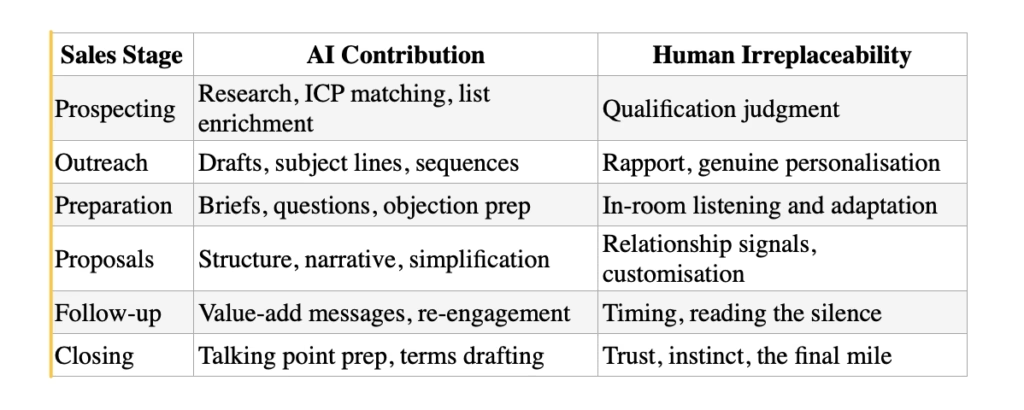
The Takeaway
AI is not going to replace your best salesperson. But your best salesperson — armed with AI — will outwork, outprepare, and out-follow-up every competitor who is still doing it the old way.
The opportunity is not in automating your sales process. It is in freeing your sales team from the low-value, time-consuming tasks that drain energy — so they can spend more time doing what only humans can do: building trust, reading the room, and closing.
Start with one stage. Pick the one where your team loses the most time today. Build one AI-assisted workflow there. Measure the difference over 30 days. Then expand.
The playbook builds itself, one stage at a time.
Found this useful? Share it with a sales leader or business owner in your network who is figuring out how to bring AI into their sales process.