
The Quiet Launch That Deserves Your Full Attention.
On April 29, 2026, Meta did something it had never done before — it opened the door.
For years, Meta locked down access to its Marketing API, forcing agencies and performance marketers to work through Ads Manager or build painful workarounds. That era is now over.
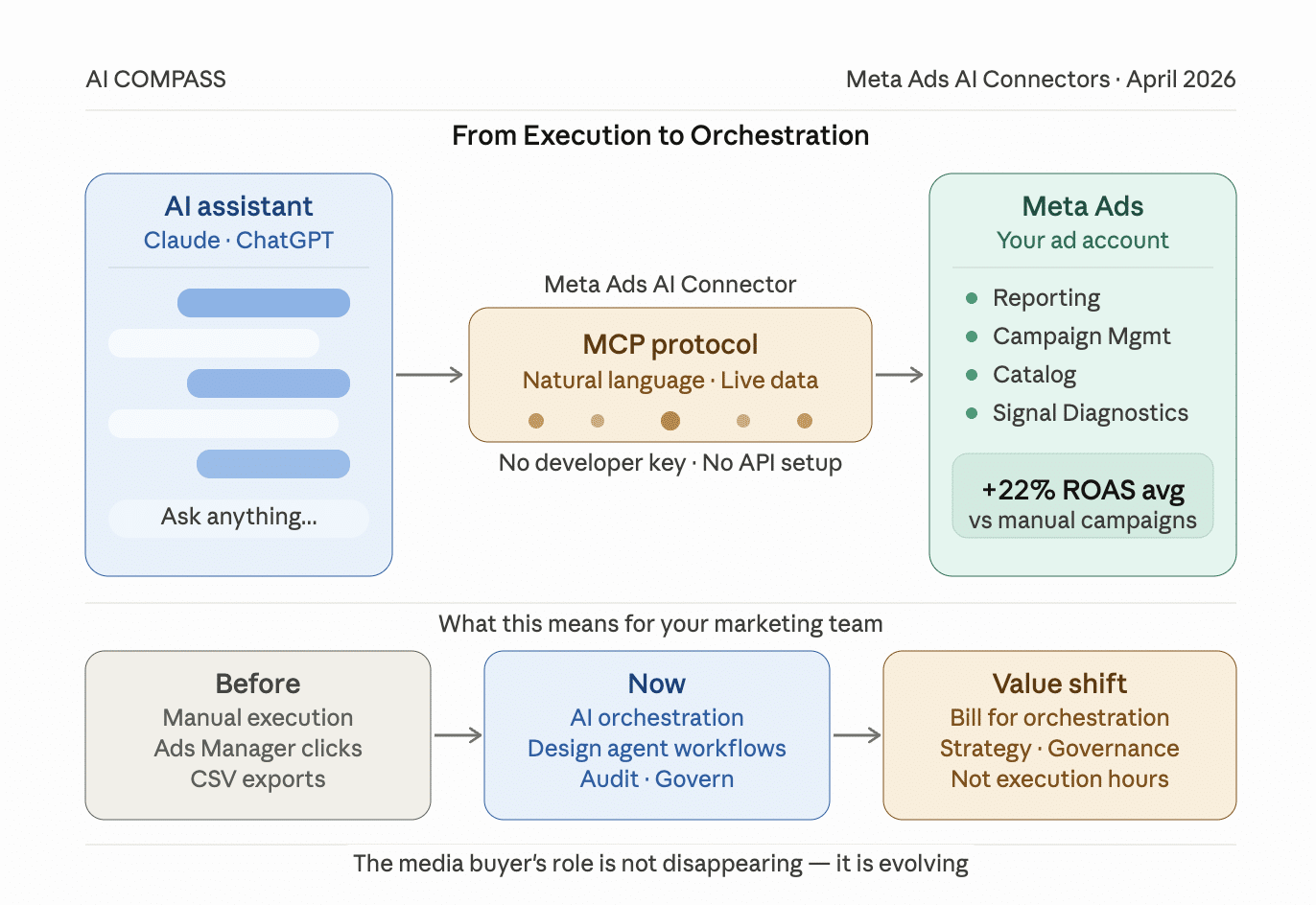
Meta Ads AI Connectors are essentially a secure bridge between your Meta Ads account and an external AI like ChatGPT or Claude. Businesses of all sizes can now create, manage, and analyse campaigns directly inside the AI tools they already use. No developer registration. No complex API setup. Just connect, authenticate, and talk to your campaigns in plain language.
What Can You Actually Do With It?
Advertisers can generate detailed reports to assess performance, create and edit campaigns using natural language prompts, manage product catalogues and troubleshoot feed issues, and access signal diagnostics to evaluate data quality and prioritise improvements — all from within a single AI conversation.
Think about what that means in practice. Your Monday morning reporting ritual — the one that takes your team half a day — can now be a two-minute prompt. As one agency head noted, AI could improve workflow on Meta, and that is a bigger deal than people give it credit for, given how manual the platform can be at scale.
What This Means for Marketing Teams and Agencies.
This is where the real conversation starts — and where business leaders need to pay close attention.
The human media buyer becomes an agent manager: designing workflows, controlling spend, auditing agent decisions, and carrying fiduciary responsibility on client budgets. The skill shifts from execution inside Ads Manager toward orchestration and governance.
In other words, the role doesn’t disappear — it evolves. The people who thrive will be those who know how to direct AI agents, not just operate dashboards.
For agencies, the pressure is more structural. For agencies, it means a new way to compress routine labour and standardise workflows. But that same compression will commoditise agencies that still bill for execution hours. Billing execution hours for tasks an agent completes in fifteen seconds leads to rapid commoditization. Billing system design, monthly audit, fiduciary responsibility, and cross-channel arbitration give a defensible revenue base.
The Bigger Picture — This Is Just the Beginning.
Meta is testing a system where advertisers input a product URL and budget, and AI generates the complete campaign, including creative assets, audience targeting, placement selection, and budget allocation across Facebook, Instagram, Messenger, and WhatsApp.
For marketing leaders, this is not just another product update. It is a sign that AI in advertising is moving from platform-controlled automation to connected workflows, where multiple tools, teams, and optimisation layers need to work together.
Advice to Marketing Leaders and Agency Heads:
Don’t wait to experiment. The teams and agencies that will win in this new environment are not the ones with the biggest headcount — they are the ones who redesign their workflows now, before the competitive pressure forces their hand.
Three questions to ask yourself this week:
- Who on my team owns the AI layer sitting on top of our Meta ad spend?
- Which of our current workflows — reporting, campaign setup, catalogue management — can be handed to an AI agent today?
- How does our agency pricing model hold up if execution is no longer where the value lives?
The door is open. The question is whether you walk through it with a plan or wait for someone else to do it for you.
Comments
Add a comment…
No comments, yet.
Be the first to comment.