

You’ve started using AI tools. Maybe you’ve even spent money on a subscription or two. But here’s the question that’s probably nagging at you:
“Is this actually making a difference — or am I just feeling productive?”
This is the most honest question in business today, and almost nobody is answering it well.
Most AI ROI conversations happen in two extremes. Either breathless claims — “We saved 10,000 hours!” — from companies with marketing budgets and data teams. Or complete silence from the majority of business owners who are quietly experimenting but have no idea how to measure the results.
You deserve something in between. A practical, no-jargon framework for measuring whether AI is genuinely working for your business — whatever its size, sector, or sophistication.
This is how we should build.
First, forget the Word “ROI” for a moment.
Traditional ROI — Return on Investment — is a financial ratio. It works beautifully for machinery, advertising spend, or real estate. You put money in, you measure money out.
AI doesn’t always work that way. Its returns are often indirect — saved time, fewer errors, better decisions, faster turnaround. These are real and valuable, but they don’t show up immediately on your P&L.
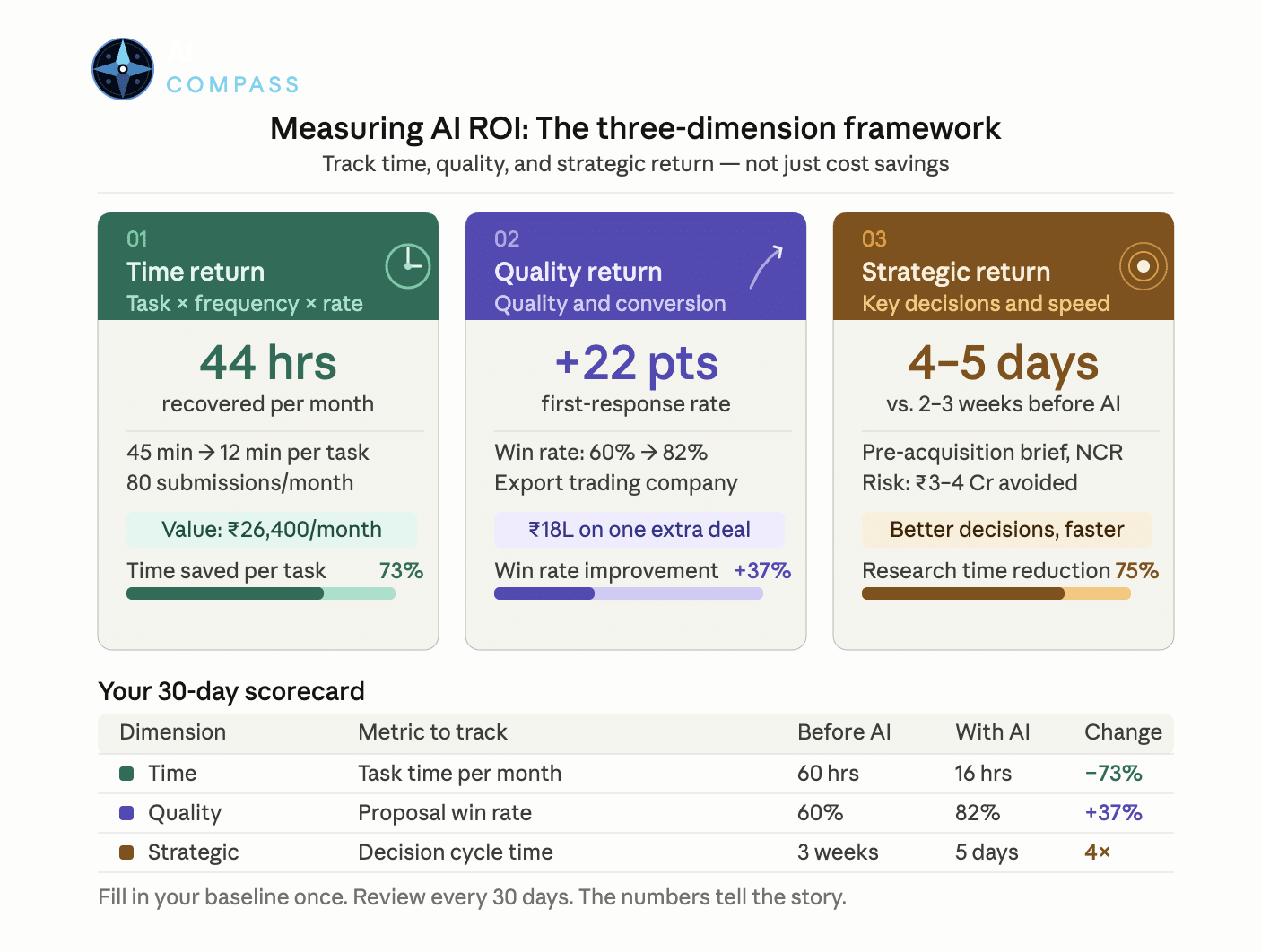
So instead of one ROI number, I want you to think across three dimensions of return:
The Three Dimensions of AI Return.
Dimension 1: Time Return
“How many hours is this saving my team — and what is that time worth?”
Dimension 2: Quality Return
” Are outputs — proposals, reports, customer responses, analysis — meaningfully better?”
Dimension 3: Strategic Return
“Am I making faster, better-informed decisions because of AI?”
Each dimension needs to be measured differently. Here’s how.
Dimension 1: Time Return — The Most Measurable.
This is your starting point because time is the most quantifiable resource in any business.
How to measure it:
Pick one AI-assisted task. Time it without AI. Time it with AI. Do this across 5–10 instances. Calculate the average time saved per task, then multiply by frequency.
The formula is simple:
(Minutes saved per task × Number of tasks per month × Hourly cost of person doing it) ÷ 60 = Monthly Time Value Recovered.
Business Case Example 1: A Recruitment Consultancy in Gurugram.
A 12-person recruitment firm was spending an average of 45 minutes per candidate to write a tailored profile summary and a covering note for client submissions. With 80 submissions a month, that was 60 hours of consultant time — at a blended cost of roughly ₹600 per hour.
After training their team to use Claude with a structured prompt template, the same task took 12 minutes — including review and editing. Time per task dropped by 33 minutes.
The math: 33 minutes saved × 80 submissions = 2,640 minutes = 44 hours recovered per month. At ₹600/hour = ₹26,400 in recovered productive capacity — every month.
Their Claude Pro subscription costs ₹1,700/month. That’s an ROI of over 15x on time alone — before accounting for quality or client satisfaction.
Business Case Example 2: A Chain of Four Retail Outlets.
The owner was personally writing the weekly WhatsApp broadcast messages, promotional captions, and festival greetings for all four stores. It consumed 3–4 hours every Sunday.
He now spends 25 minutes giving Claude a brief — upcoming offers, tone, audience, festival context — and gets 10–12 draft messages across formats. He edits and approves in another 20 minutes.
From 3.5 hours to 45 minutes per week. That’s 11+ hours a month returned to the owner — time now spent on vendor negotiations and a fifth outlet he’s planning to open.
The ROI here isn’t just financial. Its strategic capacity returned to the leader.
Dimension 2: Quality Return — Harder to Measure, Easier to Feel.
Quality returns are real but require a slightly different lens. You’re measuring things like:
- Reduction in revision cycles on documents
- Fewer customer complaints or escalations
- Higher proposal win rates
- Improved consistency in communications
How to measure it: Track one quality metric before and after AI adoption over a 60–90 day window. Choose something you already monitor — proposal conversion rate, customer satisfaction score, number of internal document revisions, or error rates in reports.
Business Case Example 3: A Financial Advisory Firm
A boutique wealth management firm in Mumbai was preparing client portfolio review reports manually. Each report took a senior analyst 3 hours, and clients frequently asked follow-up questions — suggesting the reports weren’t clear enough.
After using AI to structure the reports with a clearer narrative flow, simpler language, and consistent sections, follow-up queries dropped by 40% over two months. The senior analyst’s time per report dropped from 3 hours to 1.5 hours.
Two returns simultaneously: time saved and a measurable quality improvement (fewer follow-up calls = lower service cost, higher client confidence).
One partner put it plainly: “Our reports now read like they were written for clients, not for regulators.”
Business Case Example 4: An Export Trading Company
This Ahmedabad-based firm was losing roughly 1 in 5 international proposals at the first-draft stage — buyers would respond with lengthy clarification requests or simply not reply. The owner suspected poor structuring and unclear pricing narratives.
After using AI to restructure proposal templates — with better executive summaries, clearer pricing rationale, and buyer-centric language — their first-response rate improved from 60% to 82% over three months.
On an average deal size of ₹18 lakhs, even one additional conversion per quarter is worth ₹18 lakhs in revenue. The AI tool subscription cost? ₹4,000/month.
This is quality return translating directly into financial return.
Dimension 3: Strategic Return — The One Most Owners Overlook
This is the most undervalued dimension, and ironically, the one most relevant to senior executives and business owners.
Strategic return asks: “Are you making better decisions, faster?”
It shows up in:
- Faster competitive response because you have better market intelligence.
- More confident pricing decisions because you’ve modelled more scenarios.
- Fewer costly mistakes because you’ve stress-tested your assumptions.
This is harder to reduce to a number, but it is the most compounding return over time.
Business Case Example 5: A Real Estate Developer.
Before a site acquisition decision, a Delhi-NCR developer typically spent 2–3 weeks gathering data on comparable projects, regulatory approvals in the micro-market, and competitor positioning. Much of this was informal — conversations, broker inputs, instinct.
After incorporating AI-assisted research (using Claude for structured analysis of publicly available data, regulatory notifications, and competitor launches), the same pre-acquisition brief now takes 4–5 days and is significantly more structured.
More importantly, the quality of questions asked improved. The developer found himself going into land negotiations with better data on pricing benchmarks, demographic demand, and competitor absorption rates.
One acquisition — where AI-assisted analysis flagged a regulatory ambiguity that broker conversations had glossed over — potentially saved him from a ₹3–4 crore problem. That’s a strategic return that no formula fully captures.
A Simple Scorecard to Use Right Now
Here’s a practical tool you can use in the next 30 days. For every AI tool or workflow you’ve adopted, score it across the three dimensions:


Fill this in once a month. After 90 days, you’ll have a story — not just a feeling.
The Honest Caveat
Not every AI tool delivers ROI. Some are genuinely useful. Some are impressive-looking but solve problems you don’t have. And some require more setup time than the return justifies — at least at your current scale.
The discipline of measurement protects you from both over-investing in AI hype and under-investing out of scepticism.
The goal isn’t to use more AI. It’s to use the right AI — in the right places — and know the difference.
Your Action Step This Week:
Pick one AI-assisted task your team does regularly. Time it this week. Compare it to how long it took before. Write the number down.
That single number — honest, specific, yours — is more valuable than any industry benchmark you’ll read online.
Found this useful? Share it with a business owner or executive who’s still on the fence about AI.