

Item seven on the agenda.
You will know the scene. AI comes up somewhere around item seven. Management shows a slide of pilots, names a vendor or two, and closes with a reassuring line about “responsible AI”. One director asks whether we are moving fast enough. Another asks about data security. Heads nod, and the board moves on.
None of this is negligence. It is a vocabulary problem. Directors ask the questions they know how to ask, and AI does not fit neatly into the familiar shapes of a capex proposal or an audit finding.
I learnt a version of this lesson decades ago. When I took a technology-led executive education programme for large Indian companies, nothing moved until top management understood the method well enough to question it. AI is the same story with higher stakes.
This issue is about closing that gap: the questions boards usually ask, the seven they usually don’t, and what a good answer sounds like.
AI is on the agenda. The answers are thin.
The good news first: AI has reached the boardroom.
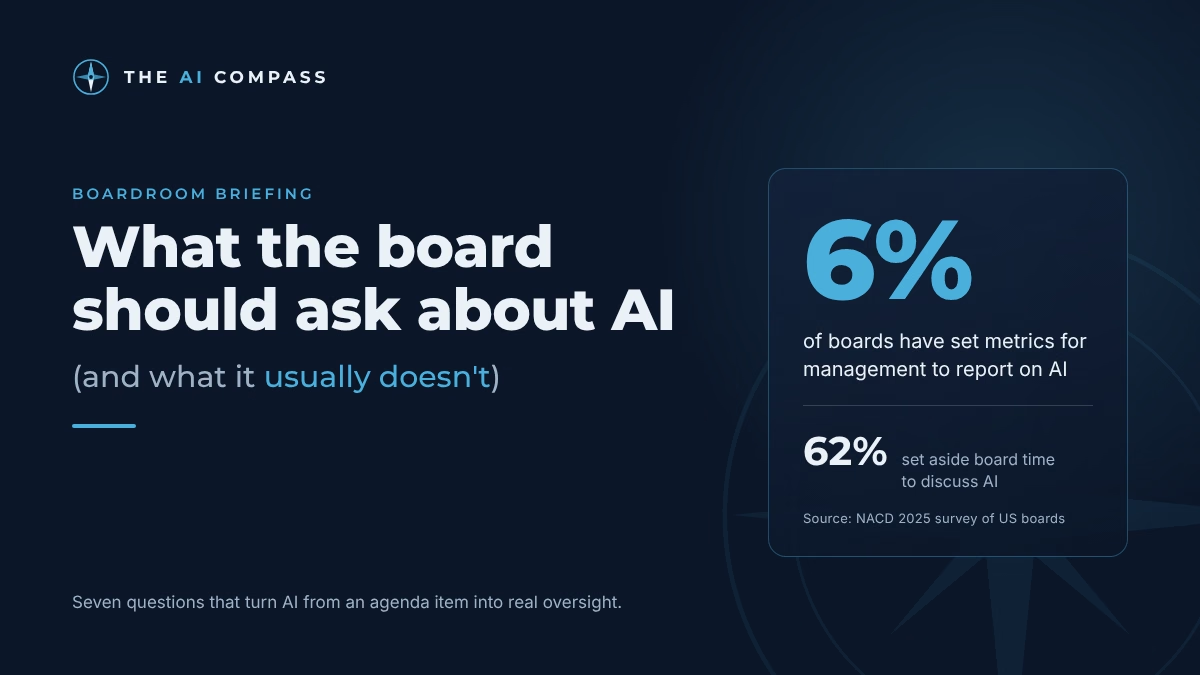
In Deloitte’s global survey of nearly 700 directors and executives across 56 countries, the share saying AI was not on the board agenda fell from 45% to 31% within a year. Among US public company boards surveyed by NACD, 62% now set aside full-board time for AI.
The harder news is about the quality of that conversation:
- Fluency. 71% of directors in PwC’s 2026 survey of about 600 US public company directors named AI as the skill their board most needs to strengthen, more than twice the next answer. In Deloitte’s survey, 66% said their boards have limited to no AI knowledge.
- Information. 82% of PwC’s respondents rated the information linking AI to risk and business performance as fair, poor or not provided at all.
- Confidence. BDO found 80% of organisations have an AI governance framework, but only 36% of directors are very confident their board has the skills to oversee it.
- Cadence. Only 26% of directors in a Protiviti–BoardProspects survey of 772 board members and executives discuss AI at every meeting, and that regularity tracked with stronger AI returns.
Meanwhile, only 12% of the 4,454 CEOs in PwC’s 2026 Global CEO Survey said AI had delivered both cost and revenue benefits.
Put plainly: boards are spending time on AI, but often without the information or the questions that would tell them whether it is working.
A word on the numbers: most of these surveys come from advisory firms that sell AI governance services, and several sample mainly US boards.
Treat them as directional, not as precise measures of Indian boardrooms.
The questions boards usually ask.
The usual questions are not wrong. They are simply incomplete. Most boardroom AI conversations circle four themes:
- Speed: Are we moving fast enough? Are competitors ahead of us?
- Security: Is our data safe? Over two-thirds of PwC’s directors name cybersecurity, data privacy and intellectual property as their top AI concerns.
- People: What will this do to our workforce? About 53% of NACD boards have asked management this.
- Spend: What are we investing, and with which vendor?
Each of these is a question about AI as a project. The questions that matter more treat AI as something the company is already doing, often in places the board has never been shown.
Seven questions boards rarely ask.
NACD’s 2025 data is revealing here. It shows what boards have done on AI, and the gaps line up almost exactly with the questions below.
1. Where, exactly, is AI already in use here?
Only about 23% of boards have audited where AI is in use inside the company. Yet AI enters through vendor software, marketing tools and the free chatbot a manager uses for customer emails. You cannot govern what you have not counted.
A good answer: a one-page AI register listing each use, its owner, the data it touches and whether it faces customers.
2. How will we know it worked?
Just 6% of NACD boards have set metrics for management to report on AI. Without them, every pilot looks promising, and none is ever stopped.
A good answer: for each major initiative, one business metric (cost per claim, days of inventory, conversion rate), a baseline, and a date by which it should move.
3. When AI gets it wrong, who owns the outcome?
In 2024, Air Canada argued that its website chatbot was responsible for its own wrong answer about bereavement fares. A Canadian tribunal rejected that and held the airline liable.
In 2025, Deloitte Australia agreed to partially refund the 440,000 Australian dollars ($290,000) paid by the Australian government for a report that was littered with apparently AI-generated errors, including a fabricated quote from a federal court judgment and references to nonexistent academic research papers. The lesson is simple: the AI never carries the liability. The company does.
A good answer: a named executive accountable for each customer-facing or decision-making AI use, and a clear review step before AI output leaves the building.
4. What will we not use AI for?
Only 36% of NACD boards have adopted an AI governance framework. A framework is really a statement of risk appetite: which decisions are off-limits for automation, and which data must never go into an external tool.
A good answer: a short, board-approved list of red lines, reviewed once a year.
5. Where is the human checkpoint, and where is the off switch?
As AI moves from drafting text to taking actions, such as approving refunds, pricing or flagging transactions, this question becomes operational. India’s market regulator is already moving to require kill switches and human oversight for regulated entities (more on this below).
A good answer: for every AI system that acts without a person in the loop, a documented threshold for human review and a tested way to stop it.
6. What does AI change about our strategy, not just our operations?
Only about 23% of NACD boards have re-evaluated corporate strategy in light of AI. The bigger question is whether AI changes how customers buy, how competitors price, or whether a product line still earns its place.
A good answer: management can name one way AI could hurt the business model and what the company is doing about it.
7. Is this board fluent enough to judge the answers?
This is the uncomfortable one. Only about 18% of NACD boards have an AI education plan for directors. Fluency does not mean every director learns to code. It means the board can tell a confident answer from a correct one.
A good answer: a short, recurring learning session for the whole board, plus access to independent expertise that does not come from the vendor or from management.
The India lens: regulators have already written the board’s homework.
Russell Reynolds’ 2026 outlook for India puts it bluntly: the country’s AI adoption, among the fastest globally, is outpacing board readiness. Indian regulators have noticed, and they are placing the responsibility squarely on boards.
- RBI. The FREE-AI framework of 13 August 2025 recommends a board-approved AI policy for regulated entities, covering governance, accountability, risk appetite, auditability and liability. It also suggests AI training for board members.
- SEBI. Its June 2025 consultation proposed a board-approved AI governance framework for market entities. On 10 October 2026, Chairman Tuhin Kanta Pandey said final guidelines would follow shortly, with tiered rules, kill switches and human oversight. His summary: “Technology cannot dilute accountability”. On October 24–25, the Chairman again said SEBI was “finalising” the AI guidelines and exploring an AI sandbox, indicating they had still not been released.
- DPDP. The Digital Personal Data Protection Rules were notified in November 2025, with full compliance due by May 2027 and penalties running into hundreds of crores. Every AI system that touches customer data sits inside this regime.
- MeitY. The India AI Governance Guidelines of 5 November 2025 deliberately avoid a new AI law and rely on existing legislation. In practice, AI harms will be judged under laws boards already answer for.
Even if RBI and SEBI rules do not bind your company, they are the clearest available template for what “good” looks like.
What to do at your next board meeting.
You do not need a new committee or a consultant to begin. Three requests will change the quality of the conversation within one or two meetings:
- Ask for the AI register. One page: every AI use, its owner, the data involved, and whether it touches customers or decisions.
- Ask for three numbers. For the biggest initiatives, the business metric, the baseline, and the target date.
- Make AI a standing item. Not a special session once a year, but ten minutes at every meeting, as Protiviti’s survey suggests (Protiviti is a global business consulting firm).
In my view, good governance has rarely been about knowing the answers. It’s about asking the next question, politely and persistently, until the answer is clear. AI does not change that. It just raises the cost of not asking.
Which of these seven questions has your board actually asked? I would value hearing what has worked in your boardroom.