


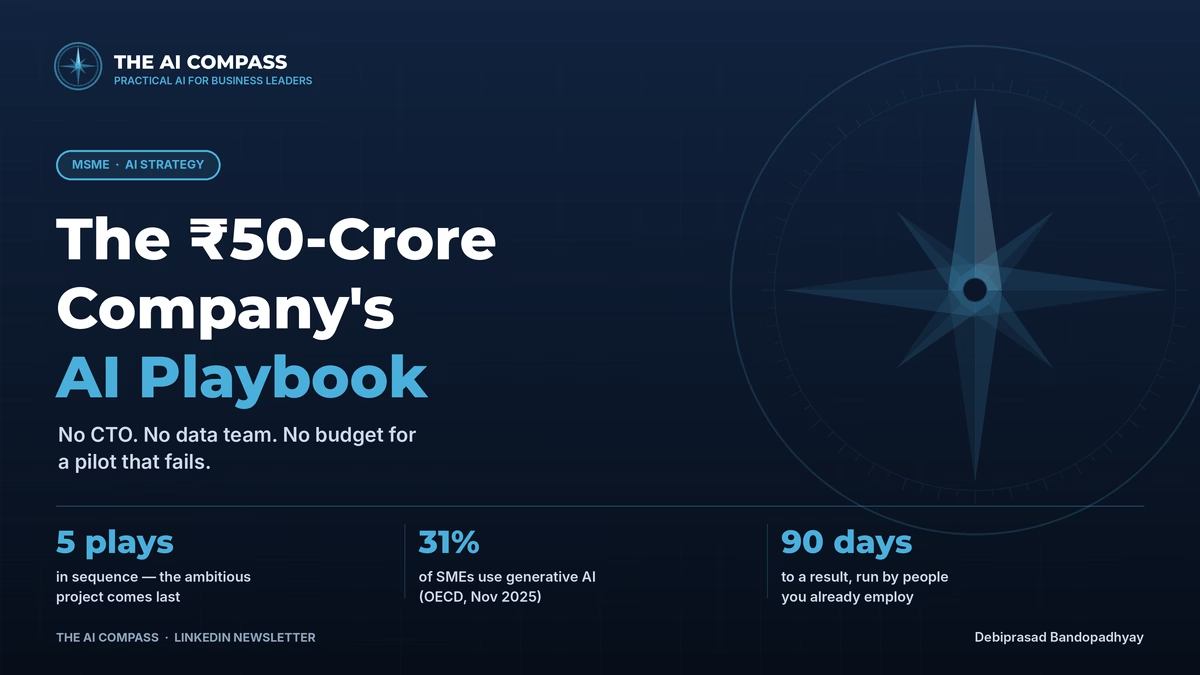
What to do when you have no CTO, no data team, and no budget for a pilot that fails.
Most AI advice is written for companies that have a Chief Data Officer.
The company I have in mind does not.
It does about ₹50 crore in turnover. It employs somewhere between 60 and 200 people. It runs on Tally or a half-configured ERP, a WhatsApp number that three people answer, a website nobody has updated since 2023, and one IT person who also handles the printers and the biometric attendance machine.
That company is not a special case. Under the classification revised with effect from 1 April 2025, a business with turnover up to ₹100 crore and plant-and-machinery investment up to ₹25 crore is a small enterprise. The Economic Survey 2025-26 counts more than 7.47 crore registered MSMEs contributing 31.1% of GDP. A large part of Indian business sits exactly here.
So this issue is a playbook for that company. Not a strategy. A sequence.
You are not as far behind as the headlines suggest.
Two Indian data points are worth holding on to.
Vi Business’s MSME Growth Insights Study 2026, drawn from its ReadyForNext platform covering more than 250,000 MSMEs across 16 sectors, found that 57% of surveyed MSMEs see AI as an important driver of growth, while about one in four has already put AI tools into its operations.
A CyberMedia Research study conducted in June 2026 found that 78% of Indian MSMEs rank operational efficiency as their top priority, ahead of revenue growth, and that 55% are looking at AI adoption.
For an independent benchmark, the OECD surveyed more than 5,000 SMEs across seven countries — Austria, Canada, Germany, Ireland, Japan, Korea and the UK — and published the results in November 2025. Generative AI was in use at 31% of them. Among firms not using it, the most common reason given was that it did not suit the work they do (57%). More than half cited concerns about copyright, legal exposure, or what happens to the information they feed into these tools.
Read those together. Roughly a quarter to a third of small firms anywhere have started. You are not late. But the ones who have started are compounding a small advantage every month, and that is worth taking seriously.
One number to treat with caution: the Google–India SME Forum report released in July 2026 projects that MSME AI adoption could unlock over $490 billion in economic value and improve profitability by 30–35%. It is based on a survey of 3,249 MSMEs, which is respectable.
But it is a projection published by a platform company with an interest in the answer. Use it to argue for attention, never to build a budget.
Three constraints that make your situation genuinely different.
Enterprise AI advice fails at your scale for three specific reasons, and every sensible decision follows from them.
Nobody owns it. A large company assigns AI to a function with a budget. In your company, anything that needs someone to configure, integrate and maintain it will quietly die within eight weeks, because the person who would have done that is closing the month-end books.
Your data is not in a warehouse. It is in Tally, in Excel files on four laptops, in a WhatsApp group, in your sales head’s memory, and in a register at the security gate. Any plan that begins with “first, consolidate your data” is a two-year project disguised as a first step.
A failed pilot actually hurts. A ₹15 lakh experiment that produces nothing is a rounding error for a listed company and a genuinely bad quarter for you.
From these, one rule: do not start anything that cannot be run by an employee you already have, and that will not show a result within one quarter. Everything below respects that rule.
The five plays, in order.
Play 1: Give paid AI accounts to six people, not sixty.
Pick the six busiest people whose work is mostly words and numbers — the person who writes quotations and tender responses, the one who drafts customer emails, the one who prepares MIS, HR, and you. Give them proper paid accounts on one mainstream assistant, not the free tier.
Skip the company-wide “AI awareness” session. Instead, take three real tasks from each person — a tender response, a customer complaint reply, a vendor negotiation summary — and work through them together.
How you know it worked in 30 days: those six people can each name two tasks that now take half the time. If nobody can, you chose the wrong six people, or nobody actually used it.
Play 2: Fix the first reply, not the whole customer journey.
Most ₹50-crore companies lose orders in the first two hours of silence, not in the CRM. The economics here are friendlier than most owners assume.
Since 1 July 2025, Meta bills the WhatsApp Business Platform per delivered message rather than per 24-hour conversation. Replies you send inside the 24-hour window opened by a customer’s own message are free, and utility messages such as order and dispatch updates cost a small fraction of marketing messages. Rates vary and change, so check Meta’s current published rate card before budgeting.
The business lesson in that pricing is clear: answering customers fast is cheap; broadcasting promotions is what runs up the bill. Put AI on the inbound reply — instant acknowledgement, price list, stock availability, dispatch status — with a human taking over anything unusual.
How you know it worked: median first-response time on WhatsApp and email, measured before and after.
Play 3: Ask better questions of the data you already have.
Do not build a data platform. Export the three reports you already run in Tally or your ERP — receivables ageing, item-wise sales, and purchase register — and use AI to interrogate them each Monday morning. Which customers have quietly stretched from 45 days to 70? Which twenty SKUs did 80% of last quarter’s margin? Which vendor’s prices moved most?
This is unglamorous, and it is where the money usually is. Strip customer names and personal details before uploading anything to a general-purpose tool.
Play 4: Write down the two processes that live in one person’s head.
Every company this size has two or three people whose departure would cause a six-month problem. Record a conversation with each of them, transcribe it, and have AI draft a working SOP, an organised instruction manual on steps, roles, decisions and expected outcome. Then have them correct it.
This costs almost nothing and reduces a risk that most owners privately lose sleep over. The OECD survey found something relevant here: among SMEs facing a skill gap, 39% of those using generative AI said it helped compensate for that gap.
Play 5: Only now, make one function-specific bet.
Quality inspection by image. Demand forecasting. Automated invoice capture. Choose exactly one, tied to your highest cost or your most frequent failure, with a named internal owner, a defined budget, and a kill date written down in advance.
Most companies at this scale start here. That is why so many stop after one disappointing pilot.
Three things not to do.
Do not buy an “AI-enabled” upgrade of software you are already underusing. If your team uses 30% of your current ERP, the AI module will be the 31st per cent nobody opens.
Do not put customer personal data into free consumer tools. India’s DPDP Rules were notified on 13 November 2025, with the substantive obligations — consent, security safeguards, breach reporting, retention limits — due to take effect on 13 May 2027, and press reports suggest the government is considering shortening that runway.
A ₹50-crore company will not be audited first. But the habits your team forms in 2026 are the ones you will have to unwind in 2027.
Do not hire a Head of AI. At this size, give an existing capable manager 20% of their time, a small budget, and a direct line to you. Ownership matters far more than expertise.
A 90-day sequence.
Weeks 1–2: choose your six people, buy the accounts, run the three-real-tasks session.
Weeks 3–8: Play 2 and 3 in parallel — first-response automation and the Monday data question.
Weeks 9–12: Play 4, and write the one-page brief for your single Play 5 bet.
For budgeting, a realistic first-year outlay at this scale is a few lakh rupees, dominated by subscriptions and one person’s time rather than software licences.
That figure is my own planning estimate, not a surveyed number — your mix will depend on headcount and how much of Play 5 you attempt.
The honest constraint.
The scarce resource in a ₹50-crore company has never been technology. It is the owner’s attention. Every one of these plays needs about an hour of your personal involvement each week for a quarter. Companies that give it see results; companies that delegate it to an enthusiastic junior and ask for a monthly update generally do not.
My question for you: if you run or advise a company at this scale, which of these five did you start with — and did the sequence hold up in practice? I have deliberately placed the glamorous play last, and I would like to know whether that matches your experience.
Every statistic in this issue is traced to a named, dated source. Vendor-sponsored research is flagged where it appears.


