
Some time ago, I enquired with a CFO running finance for a mid-sized manufacturing group, and she told me she’d sat through six AI vendor demos in a single quarter.
Every one promised to transform her forecasting, her audit cycle, working capital optimisation, faster close, etc. By the third demo, she’d stopped taking notes on the pitch and started taking notes on what the vendor avoided saying — where the data actually lived, what the contract really cost, whether it would talk to her SAP instance without a six-month integration project.
This interaction led me to further explore this area with a few experts in this field, online and offline, and some research on the various resources available, including published survey results and various AI vendor resources.
Here is the crux of my findings.
Her instinct was right. A 2025 industry survey by dMACQ found that a large majority of Indian CFOs have already adopted some form of AI — a number that outpaces global benchmarks. But adoption and transformation are not the same thing.
Most of that activity is basic document automation and reporting. The harder, more valuable evaluation — which tools genuinely earn a place in cash flow forecasting, audit, and scenario modelling, and which are demoware — is the one most finance teams haven’t done properly yet.
This issue is evaluation. No rankings dressed up as objectivity, no vendor-sponsored “best of” lists. Just a framework, an honest look at what’s out there, and the compliance and integration questions that matter more in India than in the vendor’s home market.
Start with the framework, not the feature list.
Every AI finance tool will show you a dashboard. What separates a useful evaluation from a demo-driven decision is four questions, asked in this order:
Does it solve a use case you actually have, not one the vendor has decided every CFO should have?
Where does the data live, and does that satisfy Indian regulatory requirements — not just Digital Personal Data Protection (DPDP), but sector rules from RBI, SEBI, or IRDAI if they apply to you?
Does it integrate with your actual ERP — SAP, Oracle, Tally, Zoho — without a bolt-on layer that becomes its own maintenance burden?
Is the pricing structure honest, or is “contact sales” hiding a number that only makes sense at a scale you’re not at?
Keep those four in front of you as we go through the three use cases.
Cash flow forecasting: the accuracy claims need a discount rate.
This is the most crowded category, and also the one where vendor marketing runs furthest ahead of independently verified numbers.
Platforms like Fathom (fathomhq.com) — a financial reporting and three-way cash flow forecasting tool, not to be confused with the unrelated AI meeting-notetaker of the same name.
Fathom sits on top of your accounting/ERP system and is strongest at: Pulling data from QuickBooks / Xero / Tally (via export) / SAP / Oracle / NetSuite (directly or via CSV/Excel).
It produces: management reports (P&L, balance sheet, cash flow, segment reports), KPI dashboards (margin by product, DSO, working capital metrics), Three‑way cash flow forecasts and scenario models, generating polished, board‑ready packs with charts and commentary.
Role for the CFO: Fathom becomes your single source of truth for external‑facing and board‑level financial stories, built on clean data from your core systems.
Tools like Chatfin work inside or alongside your ERP/accounting system to automate operational finance work.
Typical capabilities: Autonomous month‑end close, Validates data completeness, posts standard journals, reconciles key accounts, and flags exceptions.
AP/AR automation: Reads invoices and receipts, codes them, routes for approval, and handles collections follow‑up. FP&A agents:
Runs rolling forecasts, budget vs actual analysis, variance explanations, and draft commentary for review.
Analytics and anomaly detection: Monitors transactions for duplicates, coding errors, and potential fraud.
Role for the CFO: Chatfin‑style agents turn your finance team from data processors into reviewers and business partners, cutting close time and manual work while improving forecast quality.
ChatFin advertise forecast accuracy in the 90-97% range at 13-week horizons, aggregating real-time bank feeds, AR/AP data, and payment-timing models.
The practical gap for Indian CFOs: most of the strongest cash flow forecasting tools, including Fathom, are built for Western accounting stacks — their native integrations are QuickBooks, Xero, MYOB, and Sage, not Tally or Zoho Books, which is what most Indian mid-market finance teams actually run.
We haven’t found confirmation that Fathom or comparable tools maintain a dedicated India presence, India data hosting, or Tally/Zoho connectivity — treat that as an open question to raise directly with the vendor, not an assumption.
Before you shortlist any of these tools, ask two things explicitly: does it connect to your actual accounting system, and does it offer an India or APAC hosting region? Get both answers in writing in the contract, not just the sales call.
The AFP’s treasury benchmarking work does support the broader direction of that claim — organisations using AI-assisted forecasting materially outperform manual spreadsheet methods, roughly 88-92% vs. 60% accuracy in that survey.
But treat any single vendor’s precision figure (94.7%, 97%, and so on) as a marketing number until you’ve seen it reproduced against your own data in a pilot. Accuracy is a function of your data quality and payment predictability as much as the model.
The practical gap for Indian CFOs: most of the strongest cash flow forecasting tools are US-built and US-hosted by default. Before you shortlist one, ask directly whether it offers an India or APAC hosting region, and get that in writing in the contract, not just the sales call.
Audit automation: the Indian-native tools are genuinely ahead here.
This is the category where India-specific platforms currently outperform global generalist tools, because Indian audit work has requirements — Schedule III formats, CARO reporting, Form 3CD, GSTR-9/9C reconciliation — that global audit AI simply doesn’t handle out of the box.
Platforms like CORAA (built specifically for Indian CA firms, covering ledger scrutiny, working papers, and statutory reporting formats) and WeAudit (strong on transaction categorisation and anomaly detection, with direct Tally import) are worth a serious look if your audit function — internal or through your statutory auditor — is still running on Excel and email.
ClearTax Reconcile remains the more specialised choice purely for GST reconciliation.
The honest caveat: pricing for most of these is not publicly listed, which for a category this India-specific isn’t necessarily a red flag, but it does mean budgeting only happens after a vendor conversation. Push for a written quote before a pilot, not after.
Scenario modelling: this is where enterprise pricing gets opaque.
If you’re a large enterprise already on SAP or Oracle, your scenario modelling capability may already be sitting inside your ERP contract and underused.
SAP’s Joule assistants now handle variance analysis and natural-language queries against financial data inside S/4HANA, and Oracle’s Fusion Cloud EPM has embedded AI-driven planning that pulls directly from ERP transactional data.
If you’re already licensed for either, evaluate what you have before you buy a standalone scenario planning tool — We’ve seen more than one Indian finance team pay for a third-party FP&A platform that duplicated a module they weren’t using inside SAP.
For mid-market teams without that embedded capability, dedicated FP&A platforms (Pigment, Cube, and Anaplan are the names that come up most in this conversation) offer genuine driver-based scenario modelling, but almost none publish India-specific pricing — expect a sales conversation, and expect the number to be shaped by user count and data volume rather than a flat SaaS fee. Treat any published “starting price” as the floor, not the number you’ll actually pay.
ERP integration: the question to ask is “native or bolted on”.
This matters more than any AI feature list. There’s a real difference between AI that’s native to your ERP’s data model (SAP Joule inside S/4HANA, Oracle’s agents inside Fusion) and AI that connects via API and replicates your GL data into a separate cloud environment (true of most standalone forecasting and FP&A tools, including several mentioned above).
Neither approach is wrong, but they carry different risk profiles: native AI ties you further into your existing vendor relationship; bolt-on AI adds a data-replication step you need to govern separately, and a fragile connector layer if your ERP vendor changes its API terms.
For Indian mid-market businesses still running Tally or Zoho Books, the honest picture is that AI depth here still trails SAP and Oracle’s enterprise offerings by some distance.
Tally has no native cloud API ecosystem, which is exactly why a layer of India-built connector tools (AI Accountant, Qosh AI, and similar) has emerged specifically to bridge Tally into AI workflows — useful, but worth remembering that you’re now managing an additional vendor relationship, not eliminating one.
Data residency: what the DPDP Act actually requires — and doesn’t.
This is the section we’d read twice before signing any AI vendor contract.
India’s Digital Personal Data Protection Act, 2023, along with the DPDP Rules notified in November 2025, does not impose blanket data localisation. It works on a “negative list” model — personal data can be transferred outside India unless the destination country is specifically restricted by the government, a list that hasn’t been substantially populated yet.
Core obligations around consent and data-principal rights take full effect on 14 May 2027, so most organisations still have a runway to get compliant infrastructure in place, though building it now rather than in 2027 is the sensible move.
Where CFOs specifically need to be more careful than the general DPDP framework suggests:
Sectoral rules layer on top of it. If your business touches payment systems, RBI’s mandate requires payment system data to be stored exclusively in India, with foreign processing permitted only under strict conditions. If you’re in a SEBI-regulated entity, governance and risk data has its own localisation expectations. Insurance businesses face similar IRDAI requirements.
None of this is unique to AI tools — it applies to any SaaS vendor — but AI finance platforms that route your data through a foreign model provider add a layer worth specifically asking about: is the model itself hosted in India, or does your data leave the country to be processed even if it’s stored back in India afterwards?
Practically: before any AI finance tool goes near real transaction or vendor data, get the vendor to confirm in writing (1) where the data is stored at rest, (2) where any AI model processing occurs, (3) whether they’ll sign a data processing agreement referencing DPDP obligations, and (4) their SOC 2 / ISO 27001 status. If a vendor can’t answer all four cleanly, that’s your answer.
The honest verdict.
There is no single “best” AI tool for an Indian CFO in 2026, and any newsletter telling you otherwise is selling something. What we should actually suggest, in order:
- If you’re already on SAP or Oracle, exhaust your embedded AI capabilities before buying a standalone tool for cash flow or scenario modelling.
- For audit, the Indian-native platforms (CORAA, WeAudit) are ahead of global generalist tools, specifically because of Schedule III, CARO, and GST reconciliation support — start there if your audit process is still manual.
- For cash flow forecasting, pilot before believing the accuracy number, and get India hosting confirmed in writing.
- For Tally- or Zoho-based mid-market businesses, budget for a connector layer as a genuine additional cost and vendor relationship, not a footnote.
Whatever you choose, make the DPDP and data-residency questions part of procurement, not an afterthought raised after the contract is signed.
The tools are real, and several of them will save your team meaningful hours this year. But the vendor who answers your data residency question in one sentence, with a name and a location, is more trustworthy than the one with the most polished forecasting dashboard.
Some Additional Information Gathered from Various Online Sources:
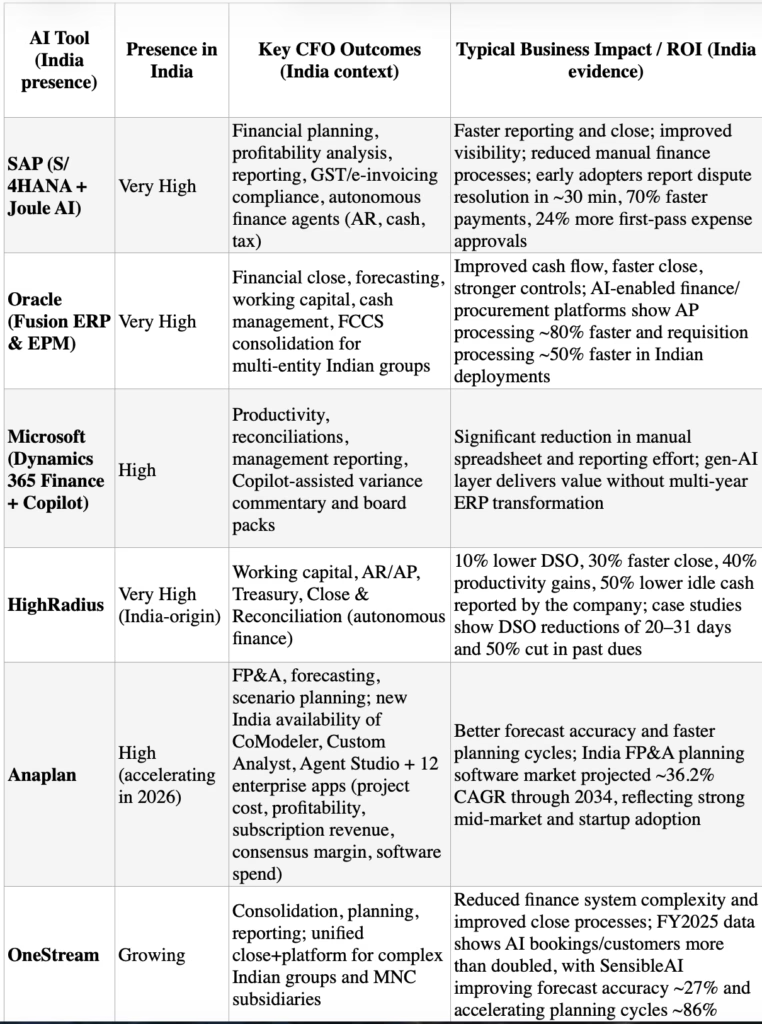
CFO AI Tools Matrix – India Focus (2026).
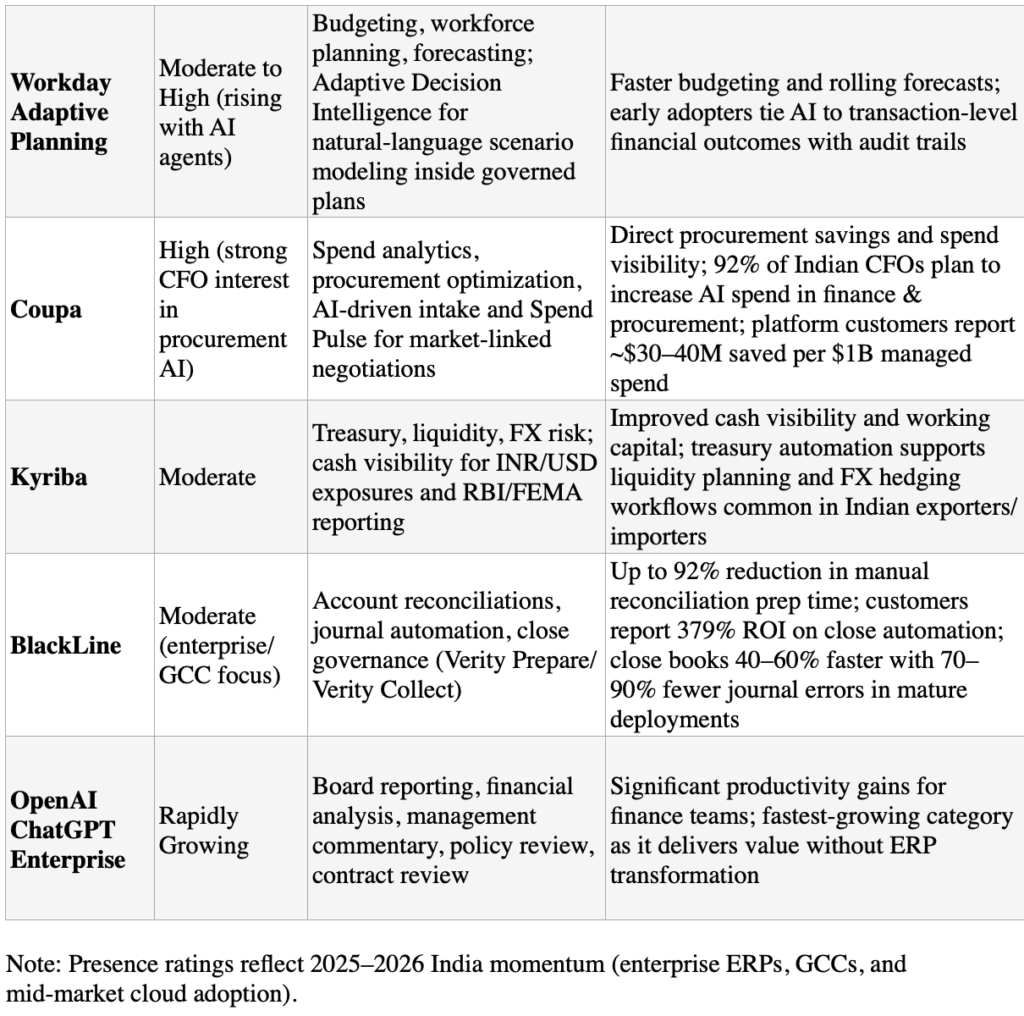
Most Common AI Use Cases Among Indian CFOs (India‑tuned)
1. Working Capital Optimisation.
Why it leads in India: Cash conversion and liquidity are primary CFO KPIs; GST/e‑invoicing and TDS workflows amplify the need for clean AR/AP data.
Leading tools: HighRadius, Oracle Fusion, SAP (Joule AR/Cash agents), Kyriba, BlackLine (invoice‑to‑cash).
Outcomes: Lower DSO (often 10–31 days in case studies), better collections, improved cash forecasting, reduced borrowing requirements.
India edge: HighRadius’s Hyderabad delivery footprint and “Autonomous Finance” positioning make it highly visible among Indian CFO forums; SAP’s e‑invoicing error‑handling agent is a priority for GST compliance.
2. FP&A and Forecasting.
Leading tools: Anaplan (new India AI suite), SAP Analytics Cloud, Oracle EPM, Workday Adaptive Planning (Adaptive Decision Intelligence), OneStream (SensibleAI).
Outcomes: Rolling forecasts, driver‑based planning, scenario modeling, forecast accuracy improvement (OneStream reports ~27% accuracy gain; planning cycles ~86% faster).
India edge: India’s FP&A planning software market is projected to grow ~36.2% CAGR through 2034, driven by startups and mid‑market manufacturers needing multi‑entity planning without heavy ERP lifts.
3. Financial Close Automation.
Leading tools: Oracle EPM/FCCS, SAP (Smart Close/Joule agents), OneStream (Modern Financial Close), HighRadius, BlackLine (Verity Prepare).
Outcomes: Faster month‑end close, automated reconciliations, reduced manual journal entries; mature deployments close 40–60% faster with far fewer journal errors.
India edge: GST e‑invoicing and intercompany complexity in Indian conglomerates make close automation a high‑ROI, low‑risk starting point.
4. CFO Productivity with Generative AI.
Leading tools: ChatGPT Enterprise, Microsoft Copilot, SAP Joule, Oracle AI Agents, Workday Adaptive Decision Intelligence
Outcomes: Automated board packs, variance commentary, financial narrative generation, policy interpretation, contract review; value without multi‑year ERP transformation.
India edge: 92% of Indian CFOs plan to increase AI spend in finance & procurement in 2026, pushing gen‑AI productivity layers atop existing ERPs.
Recommended Shortlist by Company Size in India.
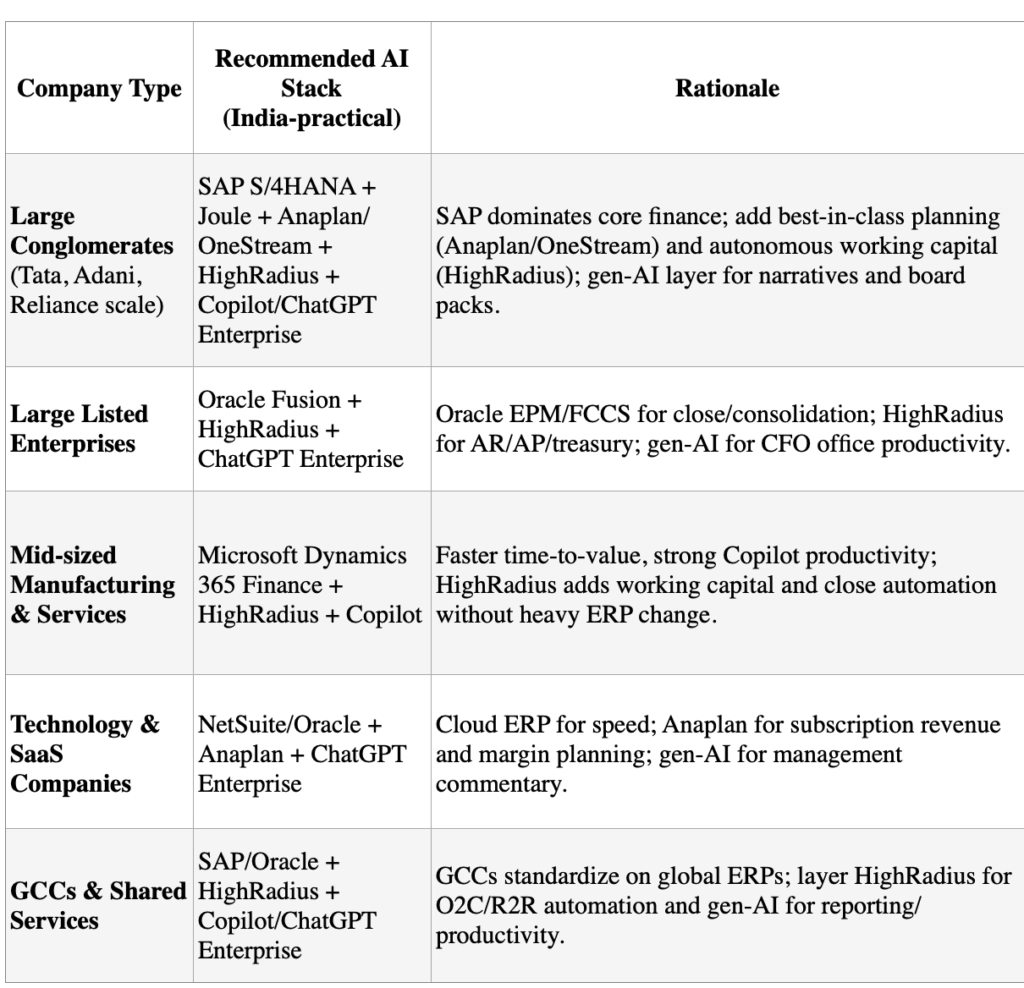
The Top 5 AI Finance Platforms Most Visible in India Today (2026).
SAP S/4HANA Finance + Joule AI – Autonomous finance agents (AR, cash, tax, planning) rolling out through 2026; strong India momentum and partner ecosystem.
Oracle Fusion ERP & EPM – Deep close/consolidation (FCCS) and cash/working capital capabilities; widely used by large listed groups.
HighRadius – India‑origin autonomous finance platform; highly visible for DSO reduction, faster close, and treasury optimisation.
Microsoft Copilot for Finance / Dynamics 365 – Productivity layer that reduces spreadsheet effort and accelerates reporting; easy to adopt alongside existing ERPs.
Anaplan – Accelerating in India with new AI tools (CoModeler, Custom Analyst, Agent Studio) and purpose‑built finance apps; strong for complex planning.
These five collectively address most CFO priorities in India: cash flow optimisation, forecasting, financial close, working capital improvement, productivity enhancement, compliance (GST/e‑invoicing), and strategic planning.
For many Indian CFOs, HighRadius, SAP, and Oracle form the core operational finance stack, while ChatGPT Enterprise and Microsoft Copilot are increasingly the AI productivity layer on top.
Optional additions to consider for India‑specific depth.
BlackLine for enterprises/GCCs needing governed close automation and reconciliation at scale (strong ROI evidence).
OneStream for groups wanting a single platform for consolidation + planning + close, especially where Oracle FCCS feels modular.
Coupa where procurement spend is a major lever; Indian CFOs are prioritising AI in procurement alongside finance.
– The AI Compass.
Sources:
Cash flow forecasting
- Coefficient, “Best 6 AI Tools for CFOs in 2026” — https://coefficient.io/cfo-resources/ai-tools-for-cfos
- Ampcome, “AI CFO Agent for Cash Flow Forecasting in India” (cites the dMACQ 2025 survey stat) — https://www.ampcome.com/post/ai-cfo-agent-cash-flow-forecasting-india
- ChatFin, “Treasury AI: How CFOs Are Using AI Agents for Cash Flow Forecasting in 2026” (cites AFP Treasury Benchmarking Survey 2025) — https://chatfin.ai/blog/treasury-ai-cash-flow-forecasting-agents-cfo-2026/
- ChatFin, “Top 10 AI Tools for Cash Flow Forecasting 2026 Edition” — https://chatfin.ai/blog/top-ai-tools-for-cfos/top-10-ai-tools-for-cash-flow-forecasting-2026-edition/
Audit automation
- AI Accountant, “Best AI Audit Tools in India (2026)” — https://www.aiaccountant.com/blog/ai-audit-tools-india-guide
- CORAA, “10 Best Audit Automation Software & Tools for CA Firms in India [2026]” — https://coraa.ai/blog/best-audit-automation-tools-ca-firms-india-2026
- CORAA, “Audit Software for Indian CA Firms in 2026: An Honest Comparison of 9 Tools” — https://coraa.ai/blog/audit-software-comparison-india-2026-honest-review
ERP / scenario modelling
- SAP, “Financial Management Software Solutions” (India page) — https://www.sap.com/india/products/financial-management.html
- SAP Community, “SAP S4 HANA Finance integration and Use case with SAP Joule” — https://community.sap.com/t5/financial-management-blog-posts-by-members/sap-s4-hana-finance-integration-and-use-case-with-sap-joule/ba-p/14193176
- Oracle, “Connected Planning” (Fusion Cloud EPM) — https://www.oracle.com/erp/performance-management/connected-planning/
- ChatFin, “Finance AI Demand by ERP: 12 Platforms” — https://chatfin.ai/research/cfo-ai-intent-index-erp/
- ChatFin, “The Autonomous Enterprise Arrives: ERP Vendors’ 2026 Finance AI Push” — https://chatfin.ai/blog/the-autonomous-enterprise-arrives-erp-vendors-2026-finance-ai-push/
- RoboCFO.ai, “7 AI-Native ERPs Rated for CFOs (2026)” — https://robocfo.ai/frameworks/ai-native-erp-landscape
Tally / Zoho / SME layer
- AI Accountant, “Tally Prime AI Tool: Automate Smarter With These Extensions” — https://www.aiaccountant.com/blog/ultimate-guide-tally-prime-automation
- AI Accountant, “Tally Integration with AI Accountant: Complete Setup and Automation Guide” — https://www.aiaccountant.com/blog/tally-integration-with-ai-accountant
- Patron Accounting, “Zoho Books vs TallyPrime 2026: Which Is Better?” (pricing figures) — https://www.patronaccounting.com/blog/zoho-books-vs-tallyprime-comparison-2026
- Qosh, “Best AI Accounting Tools in India (2026)” — https://qosh.ai/blogs/best-ai-accounting-tools-in-india-2026-complete-guide-for-cas-and-smes
- TxCount, “Tally vs Zoho Books for Bangalore Businesses” — https://www.txcount.com/blog/tally-vs-zoho-books-bangalore/
DPDP Act / data residency
- PremAI, “AI Data Residency Requirements by Region” (RBI/SEBI/IRDAI sector rules) — https://www.premai.io/blog/ai-data-residency-requirements-by-region-the-complete-enterprise-compliance-guide/
- AirRiskAware, “India’s DPDP Act and AI” (enforcement dates, MeitY IndiaAI Governance Guidelines) — https://airiskaware.com/insights/india-dpdp-act-ai-compliance
- RuleExpert, “Data Residency Requirements Explained: The 2026 Guide” (negative-list model) — https://ruleexpert.com/data-residency-requirements-dpdp-compliance/
- myitmanager.in, “DPDP Act for SaaS Companies India” (penalty figures) — https://myitmanager.in/dpdp-act-saas-companies-india/
Worth noting: several of these are vendor or vendor-adjacent blogs (Ampcome, ChatFin, CORAA, AI Accountant), not independent analyst research — fine for landscape-mapping, but we should treat their own-product claims with the same skepticism the newsletter recommends, and verify DPDP enforcement dates against MeitY’s site directly, since that’s a fast-moving regulatory area.
Please add your expert comments, particularly from your practical experience, to make this article more useful for the readers.