
Less about chatbots. More about launch timing, lending, land records and trust.
Here is a number worth pausing on. In July–September 2026, developers in India’s top seven cities launched about 1,14,320 new homes. In the same quarter, buyers took about 1,00,220. Unsold stock rose 12% in a year to roughly 6.3 lakh homes, according to ANAROCK Research.
At that quarter’s pace of sale, that is close to 19 months of inventory sitting on the shelf.
Now a second number. For the very same quarter, ANAROCK said sales rose 3%. PropEquity, another respected tracker, said they fell 6%.
Two credible firms, one market, opposite directions.
I start here deliberately. Most conversations about AI in real estate begin with chatbots, virtual site tours and “smart homes”. Those are the visible bits. The real story is quieter. This is an industry that still struggles to agree on how many homes it sold last quarter. AI’s biggest contribution will be to that problem, not to the brochure.
– First, read the fine print on the “91%” headline.
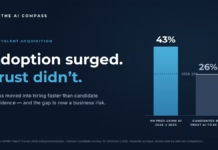
You may have seen the claim that AI adoption in Indian real estate jumped from under 5% in 2023 to 91% in 2025. It featured prominently in the FICCI–KPMG report released at the FICCI Real Estate Summit in May.
The figure comes from JLL’s Global Technology Survey 2025. Look closely at who was surveyed. It covers corporate real estate teams, the people who run office space and workplaces for companies. Not developers. Not brokers. And the measure is companies piloting or planning AI in workplace use cases, not running it at scale.
JLL itself is candid about the gap. Its India study found 57% of organisations have no clearly defined AI strategy, and many are running new tools on old, disconnected systems.
So the honest reading is this: interest is near-universal, execution is early, and the developer side of the market is a different story altogether. Keep that distinction in mind whenever someone quotes the 91%.
– Where AI genuinely changes the game.
After cutting through the noise, I see four places where AI changes how money is made or lost in this sector.
1. Deciding what to build, where and when.
The launch-versus-sales gap above is a demand-sensing problem. Developers have traditionally read the market through broker feedback, competitor launches and gut feel. That works in a rising market and hurts in a flat one.
AI models can combine registration data, enquiry patterns, price movements and infrastructure timelines at the micro-market level. The aim is not prediction perfection. It is avoiding the 400-unit tower in a micro-market that can absorb 150 a year.
The EY-Parthenon and CREDAI report GenAI in Indian Real Estate (June 2026) projects that land-to-launch cycles could compress by 20–30%. Treat that as a consultancy projection, not an observed outcome. The direction is right. The magnitude will vary by developer.
2. The pre-sales funnel.
Anyone who has enquired a property portal knows the pattern. Several calls arrive from different numbers, often days later, mostly asking the same three questions.
This is where AI is most visibly deployed today: voice and WhatsApp agents that respond within minutes, qualify budget and timeline, and book the site visit. Vendors report large gains in site-visit bookings and show-up rates. Those figures come from the vendors themselves, so I’d want to see your own A/B numbers before believing them.
The principle, though, is sound. Speed of first response matters more than polish. And a well-qualified lead saves your best salesperson’s evening for the buyer who is actually ready.
3. Construction monitoring and project finance.
This is the most underrated shift, and regulation is driving it.
The RBI’s Project Finance Directions, 2025, effective from 1 October 2025, cover commercial real estate and residential housing projects. Lenders must disburse in proportion to completion milestones certified by an independent engineer, and keep project-specific data in an electronic, accessible format.
Read that again with an AI lens. Drone imagery, site photographs and progress reports can now be checked against plans continuously, rather than once a quarter. A developer who can show clean, auditable progress data gets money faster. One who cannot will feel the friction.
The stakes are not small. In mid-2022, ANAROCK counted about 4.8 lakh homes, worth around ₹4.48 lakh crore, that were stuck or significantly delayed in the top seven cities. Most of that pain sat in NCR and MMR. Early warning is worth a great deal to the lender, and even more to the family waiting for possession.
4. The regulator and the land record.
Indian real estate’s oldest problem is title. AI cannot verify a record it cannot read.
Here the groundwork is advancing. By January 2026, 99.81% of Records of Rights had been computerised, and 97.42% of cadastral maps digitised under the Digital India Land Records Modernisation Programme. More than 37 crore land parcels now carry a Bhu-Aadhaar number.
But a Parliamentary committee noted the catch: these records were integrated in only 84.32% of villages. DILRMP 3.0, launched in September with ₹565.5 crore for 2026–31, aims to link land records, maps, registration and revenue courts.
Regulators are moving too. MahaRERA partnered with ASCI in 2024 to use AI to flag property advertisements published without a registration number or QR code, described at the time as a first for an Indian real estate regulator. Expect more of this. RERA filings are periodic, public and tedious. That is precisely the kind of data machines monitor well.
– What AI will not change.
A home remains the largest purchase most Indian families will ever make. It is decided at the dining table, often across three generations, after more than one site visit.
No model replaces the trust a buyer places in a developer’s track record. Nor the reassurance of a salesperson who returns calls after the booking. AI can make the process faster and the information cleaner. It cannot manufacture credibility.
In the 1990s, I sold technology-led executive education to companies like Tata Chemicals and Hero Honda (earlier name). The hardest part was never the technology. It was persuading top management that the method worked. Real estate’s AI journey will follow the same path. The tools are ready earlier than the boardrooms are.
– What to do on Monday morning.
If you run or advise a development company:
- Fix your data before you buy AI. Unit inventory, enquiries, bookings and cost-to-complete should live in one system you trust.
- Pick one problem with a measurable outcome. Lead response time is a good start. Measure before and after.
- Prepare for lenders who will ask for machine-readable progress data. Make it a strength, not a scramble.
If you lend to or invest in the sector:
- Treat a developer’s data maturity as a credit signal, alongside track record and balance sheet.
- Use public RERA filings as an early-warning layer. Changes in timelines and extension requests tell you a lot.
If you are a corporate occupier:
You are the 91%. Move from pilots to one use case with a clear saving, such as space utilisation or energy.
The bottom line.
AI in Indian real estate is less about the shiny front end and more about the plumbing. It is about knowing what to build, proving what you have built, and keeping the title clean.
The developers who win the next cycle will not be the ones with the cleverest chatbot. They will be the ones whose numbers their lenders, regulators and buyers can trust.
That has always been the business. AI simply raises the price of being careless with your data.
What is the one data problem in your part of real estate that you wish someone would solve? I’d value hearing from developers, lenders and brokers in the comments.
Sources consulted:
- ANAROCK Research via IANS / NewKerala and Business Today, 28–29 Sep 2026.
- Construction World.
- JLL, India’s AI Revolution in Corporate Real Estate (Feb 2026); IANS via DT Next.
- KPMG, Reimagining India’s Real Estate Landscape.
- EY-Parthenon–CREDAI, GenAI in Indian Real Estate, June 2026; figure via Construction World.
- Voice-AI vendor material, e.g. caller.digital – Vendor-sourced; deliberately not quoted as fact.
- Legal500 summary; Lexplosion
- ANAROCK via Business Standard / PTI, June 2022.
- The Week, 11 Aug 2026 (Parliamentary Standing Committee).
- Angel One, 11 Sep 2026; OdishaBytes.
- Housing.com
- Our calculation: 6,30,590 ÷ (1,00,220 ÷ 3) ≈ 18.9 months; Derived figure, not published by ANAROCK (~19 months of inventory).