
There’s a war of narratives happening in every boardroom and marketing team right now.
On one side: “AI will replace your entire marketing department.” On the other hand, “AI is just a glorified autocomplete. Don’t trust it.”
Technology promises often collide with business reality.
I’ll tell you this — both sides are wrong. And both sides are costing companies real money.
So let me give you the honest version – just a clear-eyed view of where AI genuinely earns its keep in marketing — and where it will quietly let you down if you’re not careful.
What AI CAN Do — And Do Well
1. Scale Your Content Production (Without Losing Your Voice)
This is where AI has delivered the most immediate, measurable value for marketing teams.
A mid-sized e-commerce brand was struggling to write unique product descriptions for over 4,000 SKUs. Copywriters were exhausted, and turnaround was weeks.
After deploying an AI workflow — with human review built in — they produced descriptions for all 4,000 products in under two weeks, maintaining brand tone and SEO standards.
What AI does here: Generates first drafts at scale, adapts tone across formats (email, social, landing page), and handles repetitive variations that no human wants to write.
What you still need: A human editor who knows your brand voice, understands nuance, and catches what the AI gets subtly wrong.
2. Hyper-Personalisation at a Scale Humans Cannot Match.
Imagine sending 200,000 email subscribers a message that feels like it was written just for them — based on what they browsed, bought, or abandoned.
That is not science fiction; it’s what AI-powered marketing automation platforms do every day.
Netflix reportedly saves over $1 billion annually through AI-driven personalisation — recommending the right content to keep subscribers engaged rather than churning.
For B2B marketers, AI can personalise outreach sequences based on a prospect’s industry, company size, recent activity, and funnel stage — all without a salesperson having to write 500 individual emails.
The rule: The better your customer data, the better the personalisation. Garbage data in = generic output out.
3. Make Sense of Your Marketing Data — Fast.
Most marketing teams are drowning in data. GA4 dashboards, CRM reports, ad platform metrics, social analytics — it piles up faster than any team can analyse it.
AI tools can now summarise multi-channel performance, identify anomalies (“your CPL on LinkedIn spiked 40% this week”), and surface patterns that would take a human analyst days to find.
Practical example: Tools like HubSpot’s AI assistant, Salesforce Einstein, or even a well-prompted Claude can take a dump of your monthly campaign data and give you a concise executive summary with suggested next actions in minutes.
4. A/B Testing and Optimisation — Continuously.
Traditional A/B testing takes time — you set it up, wait for statistical significance, draw conclusions, implement changes, and repeat.
AI-powered systems like Google’s Performance Max or Meta’s Advantage+ run thousands of micro-experiments simultaneously, dynamically shifting budget toward what works in near real-time.
This is a genuine competitive advantage for brands willing to set it up correctly and trust the process.
5. SEO Research and Content Strategy.
AI has dramatically accelerated keyword research, competitor gap analysis, content clustering, and topic ideation. What used to take an SEO strategist a week now takes a well-structured AI session an afternoon.
Caveat: AI cannot predict Google’s next algorithm update. It can only work with what it knows. Use it as a research accelerator, not an oracle.
What AI CANNOT Do — And Where It Will Disappoint You
1. Understand Your Customer the Way You Do
AI analyses patterns in data. It does not feel empathy.
It doesn’t explain why your customer cried at your product launch video, or what unspoken fear drives them to avoid your competitor.
The best marketing has always been built on deep human insight — conversations with customers, ethnographic research, the gut instinct of a seasoned brand manager who has seen a category for 20 years.
AI can tell you what people clicked on. It cannot tell you what they truly need.
That distinction matters enormously when you’re building brand strategy, launching a new category, or navigating a crisis.
2. Generate Truly Original Ideas.
Here’s an uncomfortable truth: AI is, at its core, a sophisticated pattern-recognition machine trained on what already exists. It is exceptionally good at remixing, recombining, and extrapolating from the past.
But the campaigns that become iconic — that shift culture, redefine a category, or make a brand unforgettable — come from a creative leap that no algorithm can reliably produce.
Think of Dove’s Real Beauty campaign. Apple’s Think Different. Amul’s real-time topicals.
These were born from a human understanding of a cultural moment, a brand truth, and a creative risk that no dataset would have validated in advance.
Use AI to accelerate ideation. Depend on humans to make the brave, creative call.
3. Build Authentic Relationships.
Relationships are built on trust, consistency, and genuine human connection. Your customers know — often faster than you think — when they’re talking to a bot, receiving a templated response, or getting content that feels hollow.
A LinkedIn comment drafted entirely by AI. A customer service response that technically answers the question but misses the emotional register. A brand post that’s grammatically perfect but utterly soulless.
AI can maintain a relationship at scale. Only humans can deepen one.
4. Navigate Ethical and Cultural Complexity.
AI does not understand context the way culture does. It can generate content that is factually accurate but tone-deaf, technically inclusive but actually offensive, or legally safe but brand-damaging.
This is not a theoretical risk. Multiple brands have published AI-generated campaigns that had to be pulled because they missed a cultural nuance, used insensitive framing, or inadvertently stereotyped.
Every piece of AI-generated content that goes public needs a human being who takes full responsibility for it. That is not optional.
5. Replace Strategic Thinking.
AI cannot set your brand positioning. It cannot decide whether to pursue a mass market or a niche. It cannot weigh the trade-off between short-term revenue and long-term brand equity.
These are judgment calls that require business acumen, market intuition, stakeholder alignment, and sometimes the courage to make an unpopular decision.
CMOs who are using AI to inform their strategy are winning. CMOs who are using AI to replace their strategy are about to learn an expensive lesson.
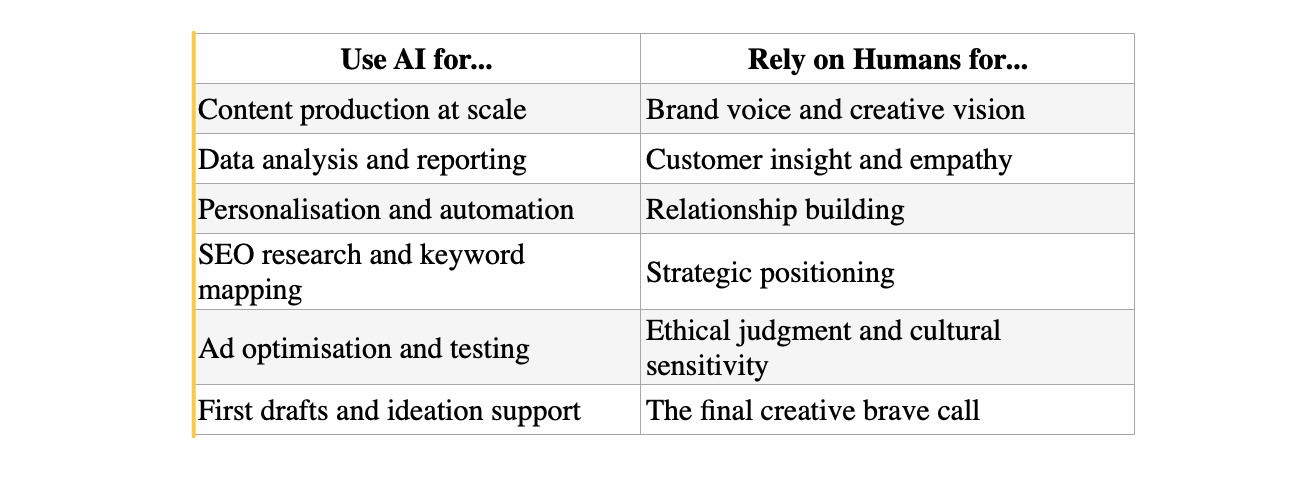
The Practical Framework: How to Think About This.
Here’s the mental model highly recommended for any marketing leader or business owner:
The Bottom Line.
AI is the most powerful marketing multiplier we have seen in a generation. But a multiplier is only as good as what it is multiplying.
If your fundamentals are strong — clear brand purpose, deep customer understanding, a talented team with strong judgment — AI will make you significantly more effective and efficient.
If your fundamentals are weak, AI will simply help you produce mediocre content faster and at a greater scale.
The marketers who will win the next decade are not those who fear AI or those who blindly defer to it. They are the ones who stay curious, stay human, and stay in charge.