


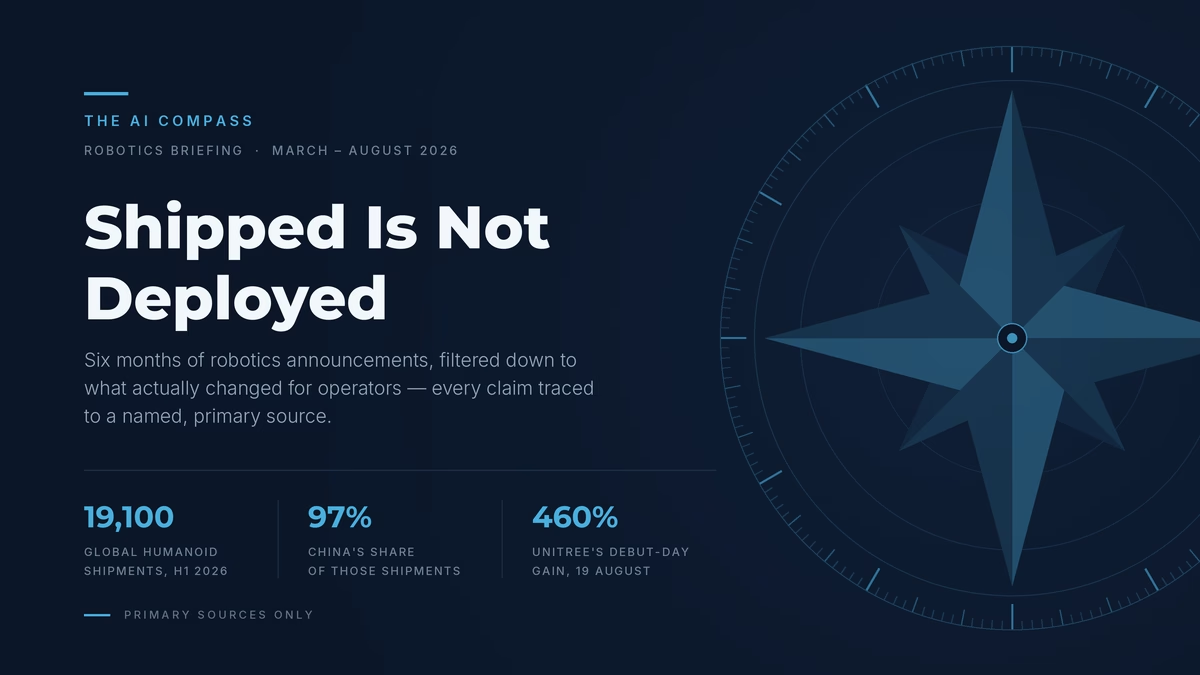
2026 is the year the Humanoid Sector got its first honest price signal and its first real regulatory constraint in the same fortnight — and the year the gap between “units shipped” and “work performed” became the number that matters.
1. Robot foundation models became a multi-vendor layer.
The biggest structural shift is that the “brain” is separating from the body.
Google DeepMind launched Gemini Robotics 2 on 30 July 2026 in three variants — a VLA model, an embodied-reasoning model (ER 2), and an on-device edge model, all in early access, demonstrated on Apptronik’s Apollo 2 doing whole-body work: walking, crouching, bending and manipulating.
Earlier generations drove the upper body only.
At GTC in March, NVIDIA put GR00T N1.7 into early access with commercial licensing, and Jensen Huang previewed GR00T N2, a world-action-model architecture NVIDIA claims succeeds at new tasks in new environments more than twice as often as leading VLA models.
Cosmos 3 followed on 31 May, announced formally at GTC Taipei on 1 June.
Primary sources: deepmind.google/blog (Carolina Parada’s post), blog.google/innovation-and-ai/technology/ai/google-ai-updates-july-2026, nvidianews.nvidia.com.
2. Manufacturing scale is real — and much smaller than the narrative.
Figure published unusually specific numbers: over 350 Figure 03 units delivered and throughput up from one robot per day to one per hour, a 24× improvement in under 120 days. The 1,000th unit came on 23 July — though that milestone was announced via the CEO’s social media, not a company release, so treat it accordingly.
1X commenced full-scale production at its Hayward, California NEO factory on 30 April, with first customer shipments planned for 2026.
Against that: Tesla confirmed on the 22 April Q1 call that Optimus production at Fremont would start in late July or August; as of mid-July it had not begun, and the Q2 delivery report contained no Optimus figures.
And the cautionary tale — Amazon confirmed on 25 February that it is no longer using Blue Jay in operations, roughly four months after launching it with considerable fanfare.
Primary sources: figure.ai/news/ramping-figure-03-production; the 1X GlobeNewswire release of 30 April; aboutamazon.com/news/operations/new-robots-amazon-fulfillment-agentic-ai (see the update note at the top).
3. The shipment numbers — and a discrepancy worth flagging.
This is where I’d be careful in print.
Smart Analytics Global put global humanoid shipments at about 19,100 units in H1 2026, more than triple a year earlier, with Chinese makers above 97% of the total; mid-year figures had AgiBot around 8,400 units and Unitree around 5,900.
But a report released on 20 August at the World Robot Conference in Beijing claimed China alone shipped more than 40,000 humanoids in H1. Those two figures cannot both be right.
The 40,000 number comes from an industry committee report presented at a trade show; I’d hedge it heavily or use the 19,100 figure with attribution.
The most useful sober line I found: analyst Georg Stieler estimated that 50–70% of humanoids produced this year could end up in “data factories” collecting training data rather than generating customer value. That distinction — shipped units versus deployed productive labour — is the whole story for a CIO audience.
Separately, MIIT deputy director Gan Xiaobin said China’s humanoid output should exceed 100,000 units in 2026.
4. Capital markets got their first real price.
Unitree sold 40.45 million shares at ¥150.80 on Shanghai’s STAR Market, raising about $904 million at roughly a $9 billion valuation, after retail investors oversubscribed more than 8,000 times — a STAR Market record. Shares closed up more than 460% on debut on 19 August, lifting the valuation to around $66 billion.
Worth noting for contrast: Unitree is profitable, with 2025 revenue of 1.7 billion yuan and 18,000 robots delivered, while Figure carries a $39 billion private valuation.
Sector-wide, Crunchbase counted $47.4 billion of venture funding into physical AI across 521 deals in H1 2026 — nearly 4× H2 2025, and more than the entire 2022–2024 period combined.
Primary Source: english.sse.com.cn (Shanghai Stock Exchange), Unitree’s prospectus.
5. Policy became a first-order variable.
On 28 July, the FCC’s Public Safety and Homeland Security Bureau released Public Notice DA 26-786, adding foreign-produced power inverters and foreign-produced advanced robotic devices to the Covered List, following two National Security Determinations sent by a White House-convened interagency body on 27 July.
The restrictions apply to new device models; they do not affect devices consumers already own, previously authorised models, or federal government purchases. Beijing accused the US of protectionism.
This is the single most consequential item for anyone with a robotics procurement decision in a US-connected supply chain.
Primary source: fcc.gov — Public Notice DA 26-786 plus the accompanying Fact Sheet and FAQ.
6. Labour caught up faster than anyone expected.
86.65% of 39,668 Hyundai union members backed strike action; partial walkouts began 13 July, with crews stopping two hours early for three days, later expanding to four-hour partial strikes per crew through 22 July. The Wall Street Journal characterised it as the car industry’s first factory stoppage addressing humanoid robots.
The union’s core demand: no robot enters a Hyundai workplace without a prior labour-management agreement.
Important nuance for accuracy — Hyundai told Ars Technica on 22 July that robot deployment forms no part of the current talks, which it described as a pay discussion.
7. Adjacent domains, briefly.
Autonomy: Waymo reached 500,000 paid rides per week across 10 US cities by late March — a tenfold increase in under two years, and launched driverless commercial service in San Diego, Las Vegas, Tampa and Denver on 8 July, against a stated target of a million weekly rides and 20+ cities including London.
Surgical: Medtronic filed 510(k) submissions on 3 June to expand Hugo into general and gynecologic specialities in the US, following its December urology clearance — the first credible challenge to Intuitive’s da Vinci in twenty-five years.
Industrial baseline: IFR’s preliminary figures show the US market up about 11% in 2025 to roughly 38,000 units. World Robotics 2026 publishes on 24 September 2026 — that’s your authoritative annual number, and it lands right after your next few issues.
On India specifically, I will release a special report sometime in September.
In the meantime, there is a news report in ET today saying that Chinese Visa curbs are hitting Indian robotics and hardware startups, leading to delays in R&D, disruptions to daily operations, and possible loss of business.


