


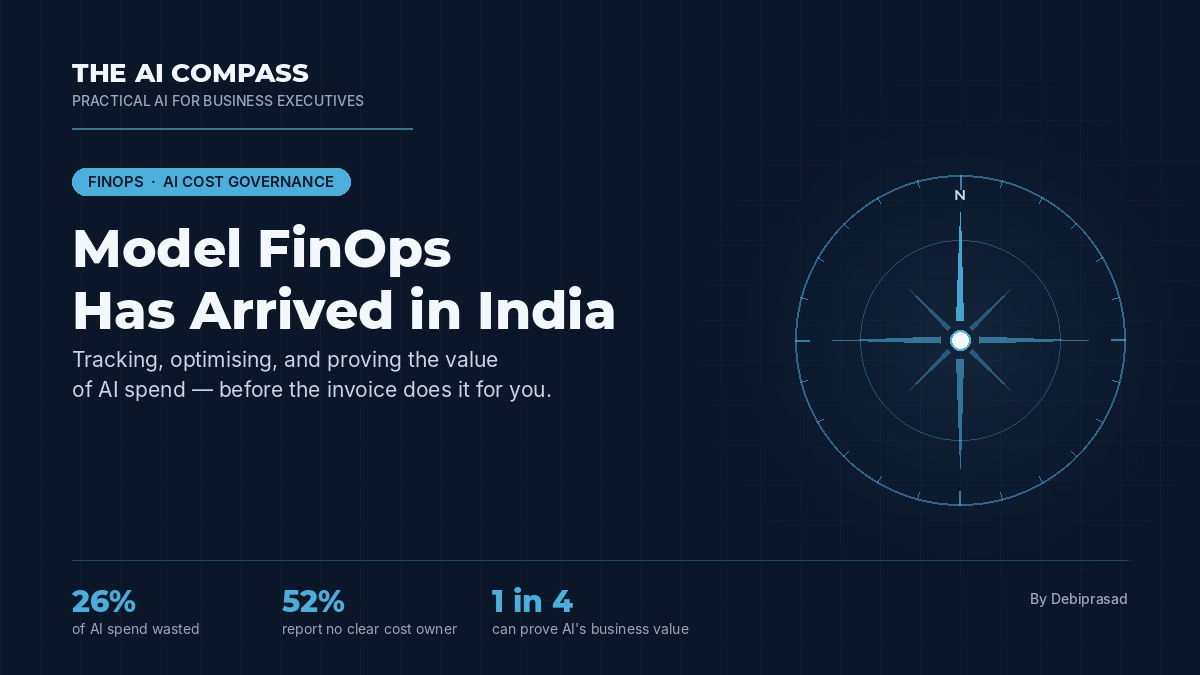
Here’s a number worth sitting with: 26%. That’s the share of enterprise AI spend that organisations themselves estimate is being wasted right now — not wasted on failed pilots, but burned inside production systems that are technically working fine. Not an outside auditor’s guess.
Their own FinOps and engineering leaders, self-reporting, in a 700-respondent survey that included 100 Indian organisations alongside cohorts in the US, UK, France, and Germany.
If you’re running AI initiatives inside an Indian enterprise or a GCC and that number doesn’t unsettle you slightly, you probably haven’t looked closely enough at the bill yet.
Why “FinOps for AI” needed to become its own discipline.
FinOps — the practice of bringing financial accountability to variable technology spend — spent the better part of a decade maturing around cloud infrastructure. Compute, storage, network: predictable unit economics, well-understood discount levers, a clear line from resource to cost.
AI broke that model. The FinOps Foundation’s own framework now treats AI as a distinct technology category, not a cloud sub-line, because the underlying economics are different in kind, not just degree: cost complexity, faster development cycles, spend unpredictability, and a much greater need for policy and governance to keep innovation aligned with actual business value.
Cost-per-token has become as fundamental a unit metric as cost-per-compute-hour once was — and just as volatile, given GPU scarcity and shifting provider pricing.
The scale of the shift in FinOps practice is hard to overstate: 98% of FinOps teams now manage AI spend, up from just 31% two years ago. That’s not gradual adoption. That’s a discipline being rebuilt in real time, under live fire, while the bills keep arriving.
What “Model FinOps” actually means in practice.
Strip away the acronym and ‘Model FinOps’ comes down to three linked disciplines, which map closely to what any experienced operator would recognise from cloud cost management — just applied to a much less predictable cost surface:
Tracking. Cost visibility down to the model, the workflow, and increasingly the individual query — cost-per-token, cost-per-query, cost-per-workflow — because a single OpenAI or Anthropic bill arriving monthly tells you almost nothing about which team, feature, or use case actually drove it.
Optimisation. Right-sizing model selection (not every task needs a frontier model), caching repeated queries, batching, committing to reserved capacity where usage is predictable, and building in fallback chains so a provider outage or price spike doesn’t become a production incident.
Value attribution. The hardest of the three, and the one most organisations are furthest behind on: connecting AI spend to a measurable business outcome — revenue growth, cost avoidance, cycle-time reduction — rather than treating “we’re using AI” as its own justification.
Only about one in four organisations globally say they have a robust method for measuring that third piece at all. Everyone can tell you what AI costs. Very few can tell you, with confidence, what it’s actually worth.
Where the deployment is really happening in India.
Global Capability Centres are the operational front line. India’s roughly 1,700 GCCs have spent the past two years pivoting from cost-arbitrage hubs to AI-native strategic centres — but that pivot hasn’t displaced cost discipline; it’s running in parallel with it.
Recent GCC leadership surveys show digital transformation topping the priority list for a majority of centres over the next year, while a majority also continue to name cost optimisation as a core focus. Industry commentary on GCC scaling is blunt about the stakes: cloud and AI cost management is described as a make-or-break issue, requiring forward-looking FinOps governance well before AI workloads reach production scale, not after.
The systems integrators have already productised it. Look at how Wipro, TCS, Infosys, and HCLTech structure their cloud FinOps delivery frameworks today, and AI/ML cost modelling isn’t a bolt-on line item — it’s built into the standard solution-design phase alongside compute, storage, and network choices.
That’s a reliable signal: when a cost discipline shows up inside a systems integrator’s standard delivery template rather than as a bespoke offering, it has moved from emerging practice to expected baseline.
India-built tooling is shaping the category, not just consuming it. This is arguably the more interesting story for readers tracking India’s position in the global AI stack.
Portkey and TrueFoundry — both built by Indian founding teams — are now cited among the leading AI gateway platforms globally for exactly this problem: routing, caching, and attributing cost across multiple LLM providers from a single control layer.
Field audits cited in the AI-gateway space have found that 40–60% of production LLM token budgets are pure waste, driven by no attribution, no rate limits, and no budget caps firing before the bill arrives — precisely the gap this category of tooling exists to close.
That India is producing infrastructure for this problem, not just deploying tools built elsewhere, is worth noting the next time someone frames Indian AI activity purely in terms of adoption statistics.
Adoption is outrunning governance depth. Recent India-specific enterprise AI research found Indian organisations reporting significant or full AI usage at meaningfully higher rates than the global average — genuinely ahead of the curve on deployment.
The same research found Indian organisations trailing global counterparts on high-level AI expertise. That combination — fast rollout, thinner specialist bench strength — is close to a textbook setup for the ownership confusion and cost surprises the global FinOps data describes: more than half of organisations surveyed report no clear owner for AI cost, and nearly three-quarters have been hit by at least one surprise AI bill in the past year.
The real gap: proving value, not just tracking cost.
If there’s a single theme worth carrying into your own AI cost conversations this quarter, it’s this: the industry’s definition of AI ROI is shifting under everyone’s feet. A large 2026 survey of enterprise IT decision-makers found that “hours saved” and productivity framing — the default justification for GenAI spend through 2024 and 2025 — is losing ground fast to hard financial metrics: revenue growth and profitability, considered together, now account for the largest share of how enterprises report measuring AI’s primary return.
That’s a harder bar to clear. It’s also the right one. Boards and CFOs are done accepting “our people are using it a lot” as sufficient evidence that an AI investment is paying off — and for organisations still at the tracking-only stage of Model FinOps maturity, that’s the gap to close next, before someone else closes it for you at budget-review time.
What this means for your organisation.
A few practical takeaways, regardless of whether you’re running AI inside a GCC, an Indian enterprise, or a smaller organisation scaling AI use for the first time:
- Name a single owner for AI cost before you add another tool or provider. Diffused accountability — split across engineering, platform, finance, and FinOps — is the single most consistent root cause behind cost surprises in every dataset examined for this piece.
- Build one unified cost view before you optimise anything. You cannot right-size what you cannot see, and most organisations are still stitching this together from separate provider dashboards and spreadsheets.
- Push cost visibility down to the point of decision — model selection, prompt design, deployment — rather than leaving it as a monthly finance report nobody sees until the invoice lands.
- Define your unit economics before you chase ROI. Cost-per-workflow or cost-per-resolved-ticket, tied to a real business outcome, is a far more defensible number in a budget review than adoption or usage statistics alone.
None of this is exotic. It’s the same discipline cloud FinOps built over the past decade, compressed into a couple of years and applied to a much less predictable cost surface. The organisations getting ahead of it aren’t the ones with the most sophisticated AI — they’re the ones who decided early that “we’re spending on AI” and “we know what that spending is buying us” have to be the same sentence.
A note on sourcing: this piece draws on a mix of global survey data (with India represented as one of five national cohorts) and India-specific enterprise research.
#AICompass #FinOps #EnterpriseAI #GCC #AICostManagement #CIO #DigitalTransformation #IndiaAI


