


Some time ago, I wrote about Param Pragya — India’s new AI supercomputing facility at IIT Delhi — and the honest gap between India’s compute buildout and what the US is doing at Argonne and Oak Ridge.
I said the interesting question wasn’t the size gap. It was what gets built on top of the compute that already exists, and who gets to use it.
Since then, a second story has been building that makes that question sharper, not smaller. It’s coming out of China, and it should change how you think about AI vendor selection — not just national AI policy.
China Found a Different Way to Win.
The US strategy for staying ahead in AI has mostly been: build the biggest, most expensive frontier models, keep them closed, and let compute scale do the talking. China’s leading labs — DeepSeek, Alibaba’s Qwen, Zhipu AI’s GLM, and Moonshot’s Kimi — have taken a different bet entirely: build models that are open-weight, dramatically cheaper to run, and good enough for most real work.
The evidence that this bet is paying off is no longer anecdotal. A US government evaluation body, CAISI, tested DeepSeek’s strongest model and found it running roughly eight months behind the leading US frontier model overall — but with that gap shrinking or disappearing entirely on specific tasks like coding, math, and tool use. That’s not “caught up.” It’s close, unevenly, task by task — which for most business use cases is close enough.
The adoption numbers are the part that should really get an executive’s attention. On OpenRouter, one of the largest model-routing platforms for developers, Chinese models now account for 61% of total token consumption and occupy the top six usage spots. When Zhipu AI released GLM 5.2 in June, Vercel’s own infrastructure lead described its first week bluntly: daily token volume grew roughly 27x, and the number of customers using it grew roughly 80x. His explanation was one sentence: price is doing the work here.
And here’s the detail worth sitting with if you’ve been assuming US chip export controls would keep China several years behind: they haven’t worked as cleanly as intended. DeepSeek and Qwen’s performance suggests Chinese labs have found ways to optimise around hardware constraints rather than being stopped by them.
Why “Open” Is The Actual Strategy, Not Just a Cost Story.
It’s tempting to read all this as simply “Chinese models are cheaper.” That’s true, but it misses the more important point. A cheaper, open-weight model spreads faster than a closed one — it becomes the default choice for developers who don’t need the absolute best model, and it builds influence globally even when the lab that built it doesn’t control every deployment. Meta tried this play with Llama. Alibaba’s Qwen has now overtaken it, capturing more than half of global open-source model downloads.
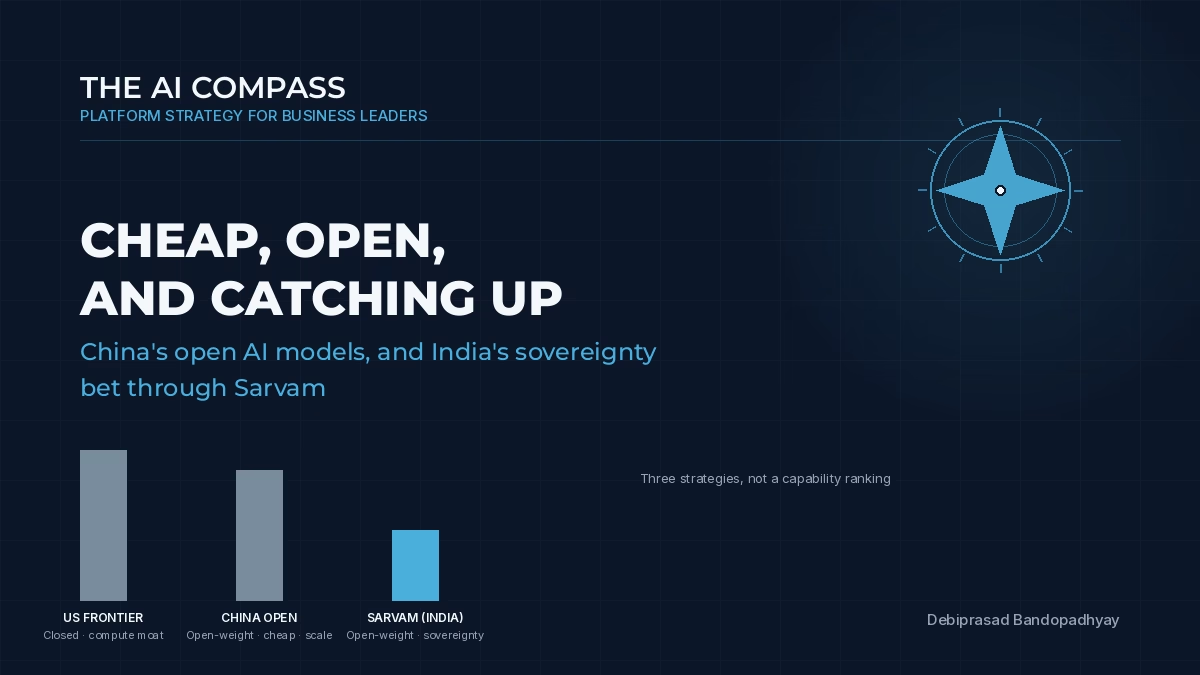
The US, by contrast, is defending its lead with closed models, because it currently holds the compute advantage and doesn’t need to give away its edge to compete. China is trying to win distribution instead of the compute race. Two entirely different theories of how you win an AI race — and it’s genuinely unclear yet which one wins on a ten-year horizon.
The Risks Your Procurement Team Should Actually Care About.
Before any Indian enterprise gets excited about running DeepSeek or Qwen at a fraction of the cost of a US frontier model, a few things are worth putting on the table plainly, because “open” and “cheap” aren’t the same as “safe to deploy”:
Data residency. Several of these models ship open-weight, meaning you can self-host and keep data entirely within your own infrastructure. But the hosted API versions — the easy, no-setup option most teams will reach for first — typically run on servers inside China, which means any data you send falls under Chinese data law.
For regulated industries, or anything touching customer PII, that’s a real compliance conversation, not a footnote.
License clarity varies by model, and by tier. Some Chinese models are genuinely open (MIT or Apache 2.0), letting you self-host and modify freely.
Others, especially the largest “flagship” versions from the same labs, stay closed or API-only even when smaller versions in the same family are open. Don’t assume the whole family shares one license just because the brand name is open-source.
Unverified claims move faster than independent benchmarking. Moonshot’s Kimi K3 launched claiming to be the largest open-source model in the world — an impressive claim that, as of this writing, no independent benchmark has confirmed. In a fast-moving field, treat lab-published benchmarks the way you’d treat any vendor’s own performance marketing: informative, not sufficient.
Governance and content behaviour differ by origin, and that’s worth testing directly against your own use case rather than assuming either way.
None of this means “don’t touch Chinese models.” It means treat the sourcing question with the same rigour you’d apply to any vendor selection — because the cost savings are real enough that procurement teams are going to ask about this whether or not you’ve built a position on it yet.
India’s Own Answer To The Same Question.
This is where it gets genuinely relevant to us, and not just as an observer. India is running its own version of exactly this experiment, through a Bengaluru startup called Sarvam AI.
Sarvam was founded in August 2023 by researchers who left IIT Madras to build AI specifically for Indian conditions — 22 scheduled languages, code-mixed speech like Hinglish, and infrastructure realities that global frontier models simply weren’t built around.
In April 2025, the Indian government selected Sarvam from 67 applicants to build the country’s first sovereign foundation model under the IndiaAI Mission. In February 2026, at the India AI Impact Summit in New Delhi, Sarvam unveiled two models — Sarvam-30B and the flagship Sarvam-105B — trained entirely from scratch on Indian compute infrastructure, not fine-tuned on top of a Western base model, and released open-weight under an Apache 2.0 license.
The parallel to the China story is worth naming directly. Sarvam is making the same open-weight bet China’s labs are making — for a different reason. China’s labs are optimising for cost and global distribution. Sarvam is optimising for something closer to what Param Pragya was supposed to represent: sovereignty. Keeping training data, model weights, and deployment inside Indian infrastructure and Indian jurisdiction, for a population and a set of languages that global frontier labs have had little commercial incentive to serve well.
Whether that bet works commercially is still an open question — Sarvam has raised a meaningful early round and was reportedly in talks for further funding at a unicorn valuation earlier this year, but a startup competing with labs that have vastly larger compute budgets faces a genuinely hard road.
What matters for this piece isn’t whether Sarvam wins. It’s that India now has a live, homegrown test case for the same strategic question China is answering at much larger scale: can a smaller compute footprint compete through focus — language coverage, cost, data sovereignty — rather than raw scale?
What We Should Tell A Board About This.
Three points, if we were briefing a board on AI vendor strategy this quarter:
One, don’t default to the most expensive frontier model out of habit. For a large share of real business tasks — drafting, summarisation, coding assistance, customer-facing chat in regional languages — a cheaper open-weight model, whether Chinese or Indian, may already be good enough. Test against your actual use case, not against a leaderboard.
Two, treat data residency and licensing as procurement questions, not afterthoughts. The cost savings on Chinese open models are real, but the governance questions are real too, and they belong in the same conversation, not a separate one that happens after the contract is signed.
Three, watch Sarvam and India’s broader sovereign AI effort not as a nationalistic curiosity, but as a genuine hedge. If you’re building AI-dependent products for the Indian market — especially anything touching regional languages, voice, or government-adjacent data — a credible domestic alternative to foreign models, open or closed, is worth having in your vendor conversation well before you actually need it.
The compute gap I wrote about two weeks ago hasn’t closed. But the more interesting race isn’t about who has the most GPUs anymore. It’s about who wins on distribution, trust, and fit for the problem actually in front of you. China is betting on price and reach. India, through Sarvam, is betting on sovereignty and language. Worth watching both closely.
The AI Compass.


