
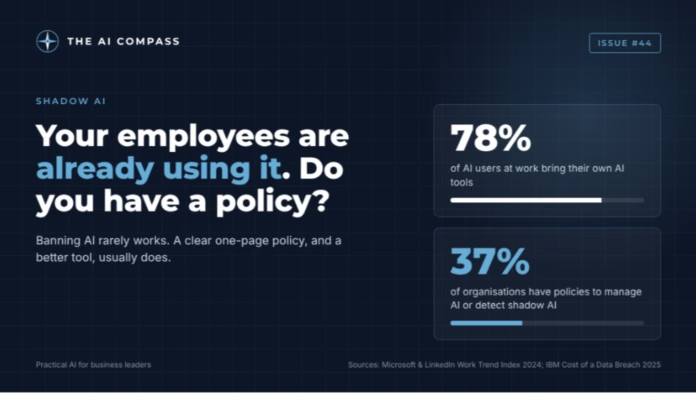
Banning AI rarely works. A clear one-page policy and a better tool usually do.
Picture a regional sales manager at 10 pm, finishing a proposal for tomorrow’s client meeting. She pastes the client’s pricing history and a draft contract into a free chatbot and asks it to tighten the language. The proposal is better by midnight. She has also just sent confidential client data to a service your company has never assessed, under terms nobody in your legal team has read.
She is not being careless. She is being productive, with the tools she can find. And in most organisations, she is not alone.
This is what the industry now calls shadow AI: employees using AI tools that the company has not approved, often without telling anyone.
The question for leaders is no longer whether it is happening. It is whether you have given your people a safe way to do what they are already doing.
How widespread is it?
The clearest early measure came from Microsoft and LinkedIn. Their 2024 Work Trend Index surveyed 31,000 people in 31 countries. 75% of knowledge workers said they used AI at work. Of those, 78% were bringing their own AI tools rather than using ones the company provided. Only 39% had received any AI training from their employer.
India is further along, if anything. A Netskope Threat Labs report on India, reported by Business Standard in August 2026, found 82% of workers in India interacting directly with AI applications. The same report says Indian organisations logged more than 3,000 AI-related data policy violations a month on average. Source code made up 49% of those violations; regulated data and intellectual property made up 23% each.
A note on that source: Netskope sells data-protection software, so it has an interest in the problem being large. The direction of the finding, however, matches the independent studies cited here.
What it costs when it goes wrong.
The most useful cost data comes from IBM’s Cost of a Data Breach Report 2025, researched by the Ponemon Institute across 600 organisations. Again, IBM sells security products, so read it with that in mind.
Three findings stand out:
- One in five organisations reported a breach caused by shadow AI.
- Only 37% have policies to manage AI or detect shadow AI.
- Organisations with high levels of shadow AI paid, on average, US$670,000 more per breach than those with little or none.
Shadow AI incidents also exposed customers’ personal information more often: in 65% of cases, against a 53% average across all breaches.
For Indian companies, that is where the DPDP Act comes in. Customer data pasted into an unapproved tool can quickly become a compliance question, not just an IT one. (We covered the DPDP angle in issue #40; your legal counsel should confirm how it applies to you.)
For an Indian benchmark, Analytics India Magazine reports that IBM’s India figures put the average cost of a breach at ₹25.5 crore, with shadow AI adding ₹1.7 crore. I could not trace the original India report, so treat those as indicative.
Why banning it rarely works.
The instinctive response is to block the tools. Samsung tried exactly that.
In 2023, Korean media reported that Samsung engineers had pasted confidential source code into ChatGPT to fix a faulty database and that another employee had uploaded a full meeting to generate minutes.
As Fortune reported, Samsung responded with a memo banning generative AI tools, with violations punishable up to dismissal. Within days, it clarified that the ban was temporary and said it would build its own tools for tasks like translation and document summaries.
That second step is the real lesson. A ban buys time. It does not remove the need that drove people to the tools in the first place. Block the obvious services, and the work moves to personal phones and home laptops, where you have even less visibility.
The Netskope India data hints at what does work. Over the past year, it reports, personal AI use at work in India fell from 79% to 41%, while use of organisation-managed AI tools rose from 30% to 77%. When companies offer a sanctioned option, most people take it.
As Tarun Wig, CEO of Innefu Labs, put it to Business Standard: “The goal isn’t to restrict AI; it’s to make the safe path the obvious one.”
What goes into a one-page AI policy.
Most companies do not need a 40-page framework. They need one page that every employee can read in five minutes and remember. Here is what I would put on it:
- Why we have this policy. One line: we want you to use AI, and we want you to use it safely.
- Approved tools. Name them. Explain how to request a new one and how quickly you will respond.
- A traffic-light rule for data. – Green: public information, your own drafts and general questions. Any approved tool. – Amber: internal, non-sensitive material. Approved company tools only. – Red: customer personal data, unpublished financials, source code, contracts, passwords. Never, unless a specific tool has been cleared for it.
- You remain responsible. Check the output. No decision about a customer, an employee or money is made by AI alone.
- Say when AI helped. Especially in client deliverables and anything that goes outside the company.
- Report mistakes early, without blame. People will paste the wrong thing. You want to hear about it in an hour, not a year.
- An owner and a review date. One named person, and a review every six months, because the tools change that fast.
A 30-day plan to get there
Week 1: Ask, don’t accuse. Run a short, anonymous survey: which AI tools do you use, and for what? You will learn more in a week than an audit would tell you in a quarter.
Week 2: Pick the safe path. Approve one or two business-grade tools that cover the most common uses, with data protections you have actually checked.
Week 3: Publish and explain. Release the one-page policy with a 30-minute session for managers. Show examples of green, amber and red.
Week 4: Assign ownership. Name the policy owner, set the six-month review, and agree how new tool requests will be handled.
None of this needs a large IT budget. It needs a leader who decides that the quiet, unofficial use of AI should become open, guided and safe.
The question for your next leadership meeting.
Don’t start with “Should we allow AI?” Your employees have already made that decision. Ask instead: “Which AI tools are our people using today, and what data is going into them?”
If nobody in the room can answer, that is your starting point.
I would like to hear from you. Does your organisation have an AI usage policy yet, and if so, what is the one rule you would not leave out? Share it in the comments.
https://substack.com/@debiprasadbando