
A strategic wake-up call, written without the fear-mongering.
Over the past few months, one question has come up more than any other in my conversations with a few business owners. It usually arrives quietly, after the formal discussion is over: “My competitors are talking about AI everywhere. Am I already too late?”
It deserves a calm answer, not a panicked one. My short response is ‘probably not’. But the window for a deliberate response is narrower than it looks. And the businesses that fall behind will not do so because they were slow to buy tools. They will fall behind because they misread what kind of race this is.
Let me explain, with two stories most of us lived through.
First, a reality check on “my competitor has adopted AI”.
When a rival announces it has “adopted AI”, it is worth asking what that actually means. The data suggests it often means less than the press release implies.
McKinsey’s latest global survey, The state of AI in 2026, published in August with 1,719 respondents across 97 countries, found that 89% of organisations now use AI regularly in at least one business function. Yet only 37% report any positive contribution to EBIT from AI, essentially unchanged from the year before. The group McKinsey calls “AI high performers”, those attributing 5% or more of EBIT to AI, remains about 6% of respondents.
Read that again. Nearly everyone is using AI. Very few are making real money from it.
So the honest picture is this: your competitor’s AI adoption is most likely a set of licences and pilots, not yet a moat. That is the reassuring part. The less reassuring part is that the 6% are not doing anything magical. They are doing something specific and repeatable, and once a few players in your industry start doing it, the gap begins to compound.
Lesson one: the early internet, and a bookstore that outsourced its future.
In 2001, Borders, then one of America’s largest bookstore chains, handed its entire online store over to Amazon. Shoppers on the Borders website were, in effect, buying through Amazon’s platform. At the time, it looked sensible. E-commerce was still recovering from the dot-com crash, and running a website seemed like a non-core cost.
What Borders gave away was not just a website. Every online customer built a purchase history on Amazon’s systems, not Borders’. Analysts later singled out the deal as a key error. Borders moved to take its online business back around 2007–08, but by then the ground had shifted.
The company filed for bankruptcy in February 2011 and liquidated its remaining stores that September. Barnes & Noble, which had built its own online presence, survived.
The lesson is not “adopt every new technology early”. Borders did go online in 2001. In a sense, it adopted. The lesson is subtler: it outsourced the learning. It let a competitor accumulate the customer knowledge, the data, and the operating know-how. Seven years is a long time to let someone else learn on your behalf.
Lesson two: mobile payments, and the QR code at the kirana counter.
Now a story closer to home. UPI went live in 2016. In August that year, its first full month of operation, it processed roughly 92,000 transactions. Even after demonetisation in November 2016, adoption crawled. Monthly transaction value stayed under ₹10,000 crore until December 2017.
Fast-forward to October 2026: UPI processed 25.47 billion transactions worth ₹31.53 lakh crore in a single month.
Here is the interesting part for our purposes. The neighbourhood kirana that put up a QR code early did gain an edge over the one that waited. But the edge was temporary. A static QR code costs almost nothing and takes minutes to set up, so the late adopter caught up quickly. Payment acceptance became table stakes, not a differentiator.
That is a very different story from Borders. Same broad wave of digital change, completely different competitive dynamics.
The distinction that matters: commodity AI versus compounding AI.
Put the two stories side by side, and you get the most useful lens I know for thinking about AI competition.
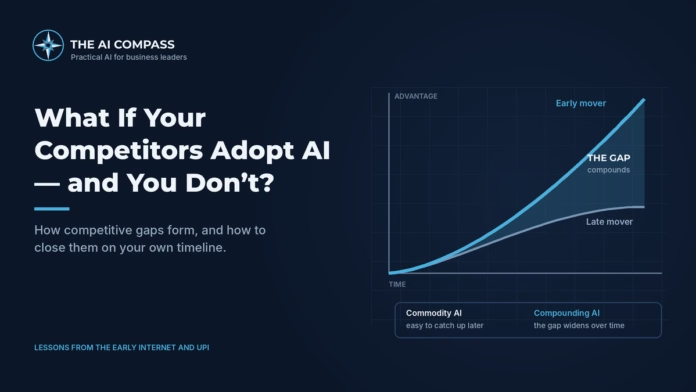
Commodity AI is like the UPI QR code. Drafting emails faster, summarising documents, a chatbot on your website, meeting notes. Everyone will have these, and they get cheaper every year, and you can catch up whenever you choose. Being late here costs you a little efficiency. It will not cost you the business.
Compounding AI is like Borders’ online store. This is AI woven into a core workflow, such as how you price, forecast demand, serve customers, or assess risk, where every month of use generates data and organisational learning that make the next month better.
Here the gap widens over time. Catching up is expensive because you cannot buy back the years of learning your competitor has banked.
McKinsey’s findings point the same way. The clearest difference between high performers and everyone else is not which tools they bought. Nearly three-quarters of high performers report fundamentally redesigning workflows because of AI, against about a quarter of other respondents. Meanwhile, 80% of respondents say AI has improved their personal productivity, yet for most companies that has not reached the profit line. Time saved by individuals only shows up in the P&L when someone redesigns the work around it.
So the real question is not “Have my competitors adopted AI?” It is “Is any competitor building compounding AI into a workflow my customers care about?”
Closing the gap on your own timeline.
The good news is that you can respond deliberately, at a pace your organisation can absorb. Here is how I would approach it.
- Sort your competitors’ AI moves into the two buckets. Most announcements will turn out to be commodity AI. Note them, plan to match them in due course, and stop losing sleep over them. Flag anything that touches a core workflow (pricing, service, fulfilment) for closer attention.
- Choose two or three workflows, not twenty use cases. Pick the workflows where better decisions or faster cycles would be visible to your customers. Redesign them end to end rather than bolting AI onto the old process. This is where compounding begins.
- Own it at the top. In McKinsey’s survey, high performers were twice as likely to say senior leaders show real ownership of AI initiatives. I learned this long before AI. In the late 1990s, when we took our executive education programme online over companies’ internal LAN networks, no client adopted it until we had first educated their top management on how and why it worked. Technology adoption follows leadership conviction, not the other way round.
- Measure in rupees, not hours saved. “My team saves five hours a week” is a fine start, but it is not a business result until those hours are redeployed into growth, quality, or cost. Decide upfront what change in cost, revenue, or customer outcome would count as success.
- Keep the learning in-house. Use vendors and tools freely, but do not outsource the understanding. Make sure your own people know how the workflow works, own the data it generates, and can explain why the system decides what it decides. That is the Borders lesson in one line.
A sensible rhythm is one workflow per quarter, reviewed honestly at the end of each. That is not a crash programme. It is a steady build that compounds.
A closing thought.
Over a long career, I have watched more than one wave of “adopt or die”, from the internet to mobile payments. In each of them, the businesses that suffered were rarely the ones that moved a little late. They were the ones that did nothing for too long or did the wrong thing quickly and called it strategy.
AI will be no different. You do not need to win the race to adopt. You need to be clear about which parts of your business can afford to follow, and which parts you must start learning in now.
The competitor to watch is not the one with the loudest AI announcement. It is the quiet one redesigning a workflow your customers care about.
Which workflow in your business would you redesign first? I would genuinely like to hear your thoughts in the comments.
https://substack.com/@debiprasadbando