
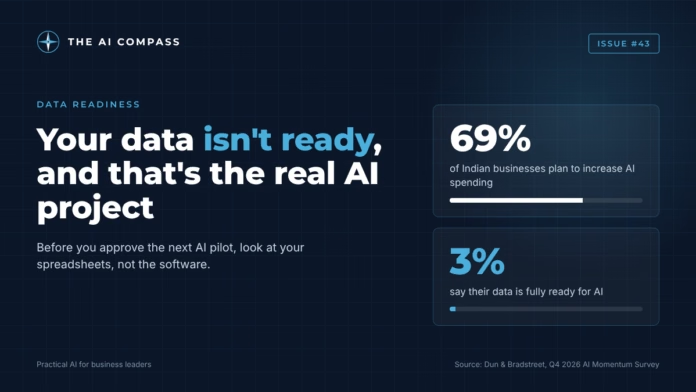
Before you approve the next AI pilot, look at your spreadsheets, not the software.
Two numbers from a survey published last week deserve a place on every Indian board agenda.
According to Dun & Bradstreet’s Q4 2026 AI Momentum Survey, 69% of Indian businesses expect to increase their AI spending over the next 12 months. Yet only 3% say their enterprise data is fully ready to support AI. The global figure is 8%.
Read those two numbers together. Most of us are about to spend more on AI, while sitting on data that very few of us trust. That gap, not the choice of model or vendor, is where most AI money will be won or lost over the next two years.
Those of us who lived through ERP in the 1990s and CRM in the 2000s have seen this pattern before. The software was rarely the problem. The records we fed into it were. AI does not change that lesson. It simply makes the cost of ignoring it arrive faster.
What the evidence says.
Three independent sources point the same way.
Gartner surveyed 1,203 data management leaders in July 2024. 63% said their organisations either lacked the right data management practices for AI, or were not sure. On that basis, Gartner predicts that through 2026, organisations will abandon 60% of AI projects that are not supported by AI-ready data. That is a forecast, not a count. But it comes from the people who run the data, describing their own house.
RAND, the US research organisation, interviewed 65 experienced data scientists and engineers about why AI projects fail. Their 2024 report named five root causes. The first was leaders misunderstanding the problem to be solved. The second was that the organisation simply lacked the data needed to make the AI work.
Dun & Bradstreet adds the commercial angle. In the same Q4 2026 survey, businesses with fully AI-ready data were 6.3 times more likely to report broad or strong returns than those whose data was only partially ready. That is a self-reported correlation, so treat it as a strong signal rather than proof. Still, it is the clearest line I have seen between data discipline and AI payback.
For balance: Indian enterprises are not standing still. The EY-CII AIdea of India: Outlook 2026 survey of 200 organisations found 47% already have multiple generative AI use cases live. Even so, EY and CII both name data readiness as a challenge that persists. Momentum is real. So is the foundation problem underneath it.
What “not ready” looks like in an Indian company.
You do not need a data audit to recognise the symptoms. Most of us have seen several of these in our own organisations:
- One customer, three names. The same client appears differently in accounts, in the CRM and in the dispatch register. No one is sure which version is right. To add further to the confusion, among the Bengalis, certain surnames have two forms, like Banerjee (anglicised version) and Bandopadhyay, in my case. An Agarwal family member may sometimes use Gupta as a surname.
- Data that lives in people, not systems. Branch stock in a local Excel file, field feedback in WhatsApp groups, pricing exceptions in a regional manager’s head.
- Free text where structure should be. “Reason for return” fields that say “misc”, “see email” or nothing at all.
- No owner. Everyone uses the data. No one is accountable for keeping it correct.
- Data you may not be allowed to use. Customer records collected for one purpose, now being considered for another. Under the DPDP Act, that is a legal question before it is a technical one.
None of this stops a demo from looking impressive. A vendor can show a polished pilot on a clean sample. The trouble starts when the pilot meets your real records, in volume, every day.
What “AI-ready” actually means.
Gartner’s definition is useful precisely because it is not about perfection. AI-ready data must be representative of the use case. It must also capture the patterns, errors and outliers that the use case will meet in real life.
In plain business terms, that means five things:
- The right data for one specific use. Not “all our data”, but the data this decision needs.
- Someone owns it. A named person, not a department.
- You know how wrong it is. Every dataset has errors. Ready means you have measured them.
- You are permitted to use it. Consent and purpose have been checked.
- It keeps flowing. The pilot used a one-time extract. Production needs a reliable, ongoing feed.
Notice what is missing from that list: the model. Data readiness is a management discipline, not a technology purchase.
A 90-day plan for the executive, not the IT team.
This is work that leaders must sponsor, because it crosses departments and changes habits. Here is a sequence I would suggest.
Weeks 1–2: Pick one use case. RAND’s research is blunt: successful projects focus on the problem, not the technology. Choose one decision that matters, such as demand forecasting for your top 50 SKUs or prioritising overdue receivables.
Weeks 3–4: Take a “data walk”. For that one use case, ask three questions. Where does each piece of data live? Who keeps it up to date? How often is it wrong? Do this with the people who enter the data, not only with IT.
Weeks 5–6: Name owners. Assign one accountable person for each critical data domain: customers, products, pricing, inventory. Put it in their goals.
Weeks 7–10: Fix at the source. Resist the temptation to clean data inside the AI pilot. Correct the forms, drop-downs and processes that create bad records in the first place. Otherwise, you will clean the same mess every month.
Weeks 11–12: Check permissions and set the budget. Confirm consent and purpose with legal. Then budget for data preparation as a business investment, not an IT overhead. If your AI business case has no line for it, the business case is incomplete.
At the end of 90 days, you may have no AI in production. You will have something more valuable: one use case where AI can actually work, and a repeatable way to prepare the next one.
The question to bring to your next board meeting.
Most AI discussions in boardrooms start with “Which tool?” or “What are competitors doing?” A better first question is simpler: “For this use case, is our data ready, and who owns it?”
If the answer is vague, the project is not an AI project yet. It is a data project. That is not a setback. It is the honest starting point, and the companies that accept it early will be the ones still running their AI projects in 2028.
I would like to hear from you. In your organisation, which dataset would you least like an AI to rely on today? Share it in the comments. I suspect many of us will recognise the answer.
– The AI Compass.
https://substack.com/@debiprasadbando